How to Calculate Your Real Monthly Trading Cost
Monthly trading cost is lots times spread and commission, plus swaps, minus any rebate. A worked gold example shows the monthly and yearly totals.
Most active traders know their spread on a single trade, but few add up what those spreads and commissions cost over a whole month. A trader who places 10 to 100 lots a month can pay hundreds of dollars in trading costs without ever seeing that total on one line. Because the money leaves the account in small pieces, one trade at a time, the monthly bill stays invisible until someone does the sum.
The calculation itself is short. It needs three inputs from the trader's own account history: how many lots were traded, what each lot cost in spread and commission, and how much was paid or received in swaps. Once those numbers are known, the same method shows how much a per-lot rebate takes off the bill, both for one month and for a full year.
What counts as trading cost
Trading cost is everything a trader pays the broker for executing positions, apart from the profit or loss of the trade itself. It has three parts, and each one is charged in a different way.
The first part is the spread, the gap between the buy (ask) price and the sell (bid) price. A position opens at one side of that gap and closes at the other, so the spread is paid once per round trip, even though no separate fee appears. To turn a spread into dollars, traders multiply the spread in price terms by the contract size. For example, if a gold contract is 100 ounces and the spread is 0.20 USD, that spread costs 20 USD per lot. The contract size differs between brokers and symbols, so it should be checked in the platform's symbol specification.
The second part is the commission, a fixed fee per lot that some account types charge on top of a very tight spread. Brokers quote it either per side (opening and closing are charged separately) or per round trip, and the difference doubles the number. Standard-type accounts usually build their cost into the spread instead, so their commission line may be zero.
The third part is the swap, the overnight financing charge or credit applied to positions held past the daily rollover. Swaps depend on the symbol, the direction of the trade and how many nights it stays open. As a result, a scalper who closes everything within the day may pay almost no swap, while a swing trader can pay a noticeable amount every month.
The monthly formula
Putting the three parts together gives one formula. Monthly cost equals lots traded multiplied by the cost per lot (spread cost plus commission), plus the net swaps for the month. In other words, spread and commission scale with volume, while swaps scale with holding time.
A rebate works on the volume side of that formula. A forex rebate, also called backcom, is a fixed amount in USD paid back for each lot that is executed, so its total also scales with volume. That means the rebate can be subtracted per lot: net monthly cost equals the monthly cost minus lots multiplied by the rebate per lot. The rebate does not change the spread or the commission the broker charges; it returns part of the money after the trade.
BackcomHub is an introducing broker (IB) for the brokers listed on the site and earns an IB commission on accounts opened through its links. The rebate figures used below come from the BackcomHub rebate table, which takes its data from dctoptrade.vn.
A worked example with gold
The example below uses a hypothetical trader and hypothetical costs to show the method. This trader places 40 lots of XAU/USD a month on an Exness Standard account. The cost per lot of 20 USD and the swap figure of 30 USD a month are illustrative numbers only, not quotes of Exness spreads or swaps, which change with market conditions.
With those assumptions, the spread cost for the month is 40 lots multiplied by 20 USD, which is 800 USD. Adding 30 USD of swaps brings the monthly trading cost to 830 USD. Over 12 months at the same pace, the bill reaches 9,960 USD, a figure that rarely appears anywhere in a trader's records.
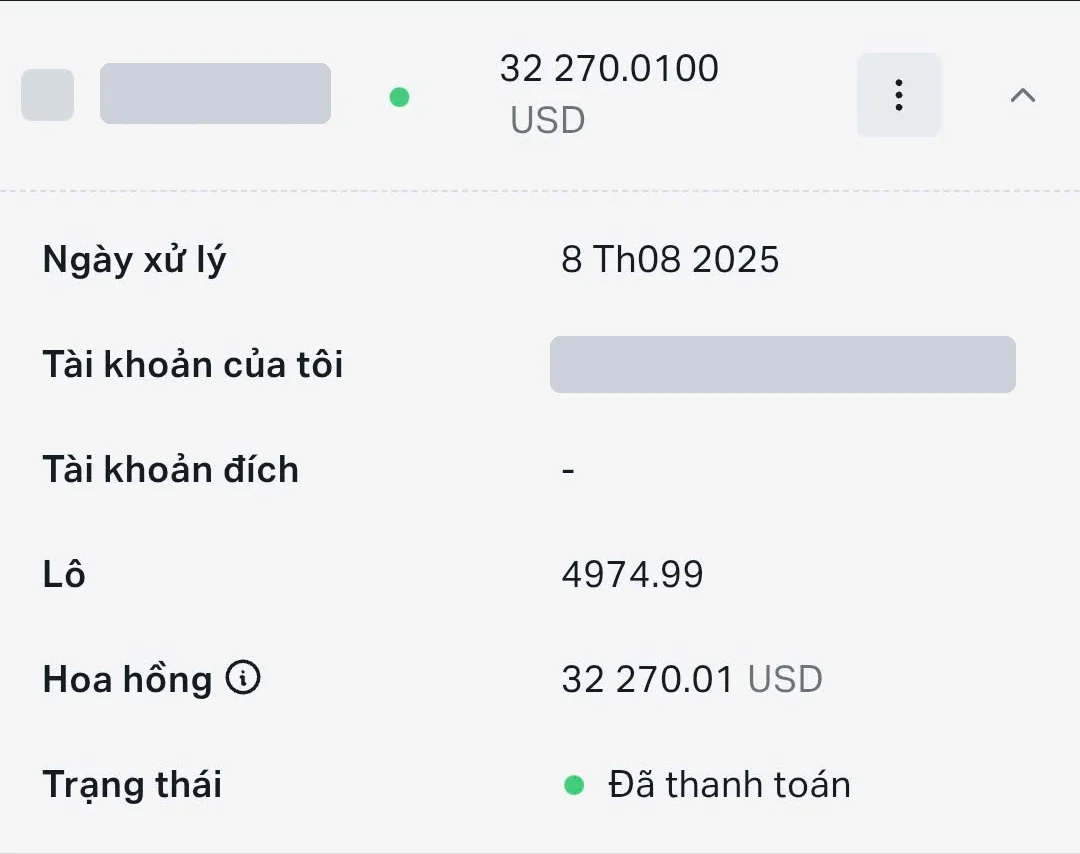
The rebate side uses a real figure. The BackcomHub rebate table lists 9.6 USD per lot for XAU/USD on Exness Standard & Cent accounts. At 40 lots, that returns 384 USD a month, so the net monthly cost falls from 830 USD to 446 USD. Over 12 months, the rebate adds up to 4,608 USD, and the net yearly cost becomes 5,352 USD instead of 9,960 USD.
Seen per lot, the rebate covers 9.6 USD of the hypothetical 20 USD spread cost, or 48 percent of it. The swap is not affected, because it depends on overnight holding rather than on the number of lots. A trader whose costs come mostly from swaps will therefore see a smaller share of the bill offset by a rebate.
Where to find the real numbers
The hypothetical figures above should be replaced with the trader's own data, and most of it is already in the trading platform. In MetaTrader 4 or MetaTrader 5, the Account History tab (History in MT5) lists every closed trade with its volume, commission and swap. Setting the period to one full month and exporting or saving the report as a statement gives the totals in one place.
The broker's own statement, usually available in the client area or sent by email, shows the same information and is useful when a trader runs several accounts. Spread cost is the one item that statements rarely show as a separate line. A practical way to estimate it is to note the typical spread on the symbol at the hours the trader usually trades, then multiply by the contract size and the monthly lot count.
The rebate side comes from the rate table of the rebate provider and the provider's payout report. Comparing the rebate actually received with lots multiplied by the listed rate is a simple check that every lot was counted.
Using the number
Once the monthly cost is on paper, it becomes a figure a trader can manage like any other expense. It can be compared with monthly profit to see how much of the gross result the costs consume. It can also be compared across account types, because a lower spread with a commission and a wider spread without one often end up close in total.
The rebate is the part of the bill that requires no change in trading style. Because it is paid per executed lot, a trader who already knows the monthly lot count can estimate the yearly saving in one multiplication before opening an account. The home page shows each broker's gold and EUR/USD rebate on its main account, with the referral code and partner link, while the full tables by account type and symbol for Exness and Vantage are in the broker rebate reviews.
Sources
- BackcomHub rebate table, data from dctoptrade.vn: backcomhub.net (Exness Standard & Cent, XAU/USD: 9.6 USD per lot; figures dated 2026-11-20)