Standard vs Raw Spread Accounts: Which Costs Less?
Standard accounts price cost into the spread; Raw accounts add a commission. Rebate gaps at Exness, Vantage and IC Markets can change which one is cheaper.
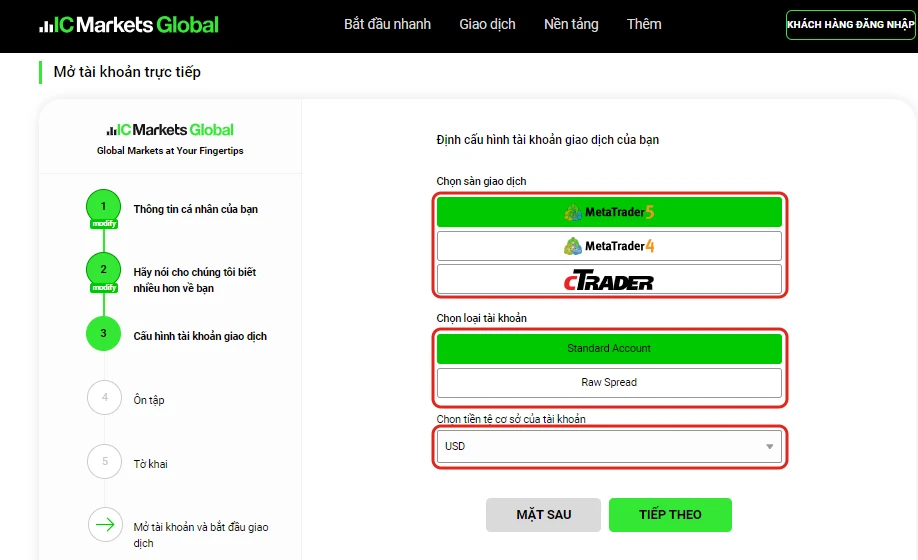
Traders opening an account at Exness, Vantage or IC Markets usually face the same choice: a Standard account with no commission, or a Raw Spread account with a very tight spread and a commission per lot. The Raw option often looks cheaper at first glance, because its spread is close to zero. However, the total cost per lot depends on how the two charges add up, and a rebate can tilt the comparison in the opposite direction.
The comparison comes down to one question per symbol: after spread, commission and rebate, which account leaves the lower net cost per lot? The sections below explain how each account charges, set the published rebates for both account types side by side, and walk through a hypothetical example that shows how the answer can change from one broker to another.
How each account charges
A Standard account builds its cost into the spread, the gap between the buy (ask) and sell (bid) price. The trader sees no commission line on the statement, but each round trip still costs the spread multiplied by the position size. As a result, the cost is real even though it never appears as a separate fee.
A Raw Spread account, also sold under names such as Raw, Zero or ECN, works the other way round. The broker shows a spread close to the underlying market price, often near zero on major pairs, and charges a fixed commission per lot instead. The commission may be quoted per side or per round trip, so traders should check which one applies before comparing.
Because the two accounts charge in different places, comparing spreads alone gives the wrong answer. The fair comparison is the all-in cost per lot: spread cost plus commission for each account, measured on the same symbol at the same hours. That all-in figure is also where a rebate enters, since a rebate is paid per executed lot.
Rebates differ by account type
A forex rebate, also called backcom, is a fixed amount in USD returned for every lot executed through an introducing broker (IB). BackcomHub is an IB for the brokers listed on the site and earns an IB commission on accounts opened through its links. The rebate is not the same across account types, because each broker sets the IB payout separately for each account type.
The table below lists the rebates in USD per lot from the BackcomHub rebate table, which takes its data from dctoptrade.vn. Exness and Vantage publish rates per symbol, while IC Markets pays one flat rate per lot on every symbol.
| Broker | Account | EUR/USD | XAU/USD |
|---|---|---|---|
| Exness | Standard & Cent | 3.20 | 9.60 |
| Exness | Raw & Zero | 0.87 | 3.00 |
| Vantage | Standard | 6.12 | 18.00 |
| Vantage | RAW ECN | 1.60 | 1.60 |
| IC Markets | Standard | 4.00 (flat) | 4.00 (flat) |
| IC Markets | Raw Spread | 2.00 (flat) | 2.00 (flat) |
At every broker in the table, the Standard account pays the higher rebate. The size of that gap is what matters for the decision. On EUR/USD, Standard pays 2.33 USD more per lot at Exness, 4.52 USD more at Vantage and 2.00 USD more at IC Markets. On gold, the gap widens to 6.60 USD at Exness and 16.40 USD at Vantage, while IC Markets stays at 2.00 USD.
A hypothetical EUR/USD example
The example below uses hypothetical costs, not quotes from any broker, and applies the same costs at all three brokers so that only the rebate differs. Assume one pip on a standard EUR/USD lot is worth 10 USD. On the Standard account, the example spread is 1.0 pip, so each lot costs 10 USD. On the Raw account, the example spread is 0.1 pip, worth 1 USD, plus a commission of 7 USD per round trip, so each lot costs 8 USD.
Before any rebate, the Raw account wins by 2 USD per lot. For a trader placing 50 lots a month, that is 400 USD on Raw against 500 USD on Standard, a saving of 100 USD. Most comparisons stop at this point, which is why Raw accounts are often described as the cheaper choice.
Adding the Exness rebates changes the order. The Standard account's net cost becomes 10 minus 3.20, or 6.80 USD per lot, while the Raw account's becomes 8 minus 0.87, or 7.13 USD. Standard is now cheaper by 0.33 USD per lot, and at 50 lots the monthly totals are 340 USD against 356.50 USD.
At Vantage, the effect is much larger because the rebate gap on EUR/USD is wider. Standard falls to 10 minus 6.12, or 3.88 USD per lot, while Raw falls to 8 minus 1.60, or 6.40 USD. At 50 lots, the Standard account costs 194 USD a month and the Raw account 320 USD, a difference of 126 USD in favour of Standard.
At IC Markets, the two accounts end up level. Standard costs 10 minus 4, or 6 USD per lot, and Raw costs 8 minus 2, also 6 USD per lot. In this case the 2 USD cost advantage of the Raw account is exactly cancelled by the 2 USD rebate gap.
The decision rule
The three results follow one rule that traders can apply with their own numbers. First, measure how much cheaper the Raw account is per lot before rebates, using real spreads and the real commission on the symbol traded. Then compare that figure with the rebate gap in the table. If the Raw account's cost advantage is smaller than the rebate gap, the Standard account is cheaper after rebates; if it is larger, Raw stays cheaper.
Symbol choice matters because the rebate gap is not the same on every symbol. On Vantage gold, for instance, the Raw account would need to be more than 16.40 USD per lot cheaper before rebates just to break even. On IC Markets, by contrast, the flat rates mean the gap is 2 USD on every symbol, so the before-rebate cost difference decides almost on its own.
Volume matters because it multiplies whatever gap remains. A difference of 0.33 USD per lot, as in the Exness example, is 3.30 USD a month at 10 lots but 33 USD at 100 lots. A trader with low volume can therefore choose on other grounds, such as how the spread behaves on entry, while a high-volume trader should run the numbers carefully.
Getting the real inputs
The hypothetical costs above should be replaced with figures from the trader's own experience. The commission is usually stated on the broker's account-type page and appears on every trade in the MT4 or MT5 account history. The spread is best measured by noting the typical value on the chosen symbol during the hours the trader actually trades, on both account types if possible.
With those two inputs and the rebate table, the comparison takes a few minutes and can be repeated for each symbol. The home page shows each broker's gold and EUR/USD rebate on its main account, with the referral code and partner link, while the full tables by account type and symbol for Exness and Vantage are in the broker rebate reviews.
Sources
- BackcomHub rebate table, data from dctoptrade.vn: backcomhub.net (Exness figures dated 2026-11-20, Vantage 2026-11-10, IC Markets 2026-10-18)