Spread vs Commission: What a Forex Trade Really Costs
How to turn spread, commission and swap into one cost in USD per lot, compare zero-spread and no-commission accounts, and see how a rebate lowers it.
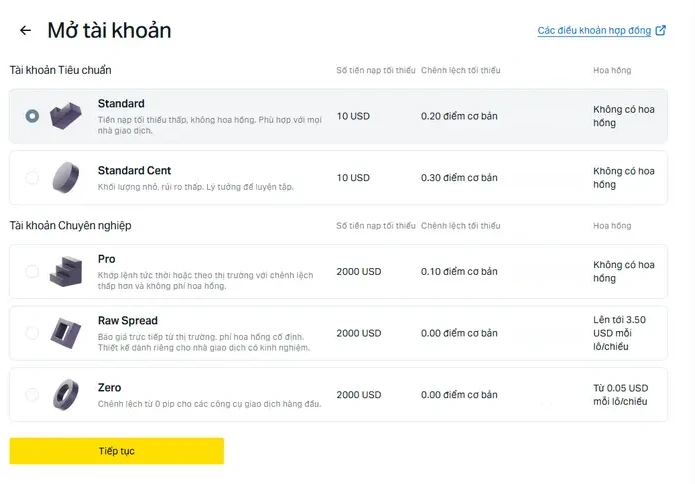
Traders choosing a forex account usually meet two offers that look like opposites. One account advertises "no commission", while another promises spreads "from 0.0 pips" but charges a fee on every lot. Each offer hides one part of the cost, so neither headline says which account is actually cheaper for a given trading style.
The fair way to compare them is to turn every charge into the same unit: US dollars per round-turn lot. That number combines the spread, the commission and, for positions held overnight, the swap. The sections below explain each part, show the calculation with clearly labelled example figures, and then show how a rebate reduces the final number differently on each account type.
Bid, ask and the spread
Every forex quote has two prices. The bid is the price at which the broker buys from the trader, so a trader who sells receives the bid. The ask is the price at which the broker sells, so a trader who buys pays the ask. The ask is always higher than the bid, and the gap between them is the spread.
The spread is a cost because a new position starts at a small loss. Take a hypothetical EUR/USD quote of 1.08500 bid and 1.08512 ask. A trader who buys at 1.08512 and closes immediately sells at 1.08500, so the trade loses 0.00012, which is 1.2 pips. That loss happens even if the market price has not moved at all.
To turn the spread into money, the trader multiplies it by the pip value. On EUR/USD, one pip is worth about $10 per standard lot of 100,000 euros. A 1.2-pip spread therefore costs about $12 per lot, $1.20 on 0.10 lot and $0.12 on 0.01 lot. The spread is paid once per trade, because it covers both the opening and the closing side.
What a round-turn commission is
A commission is a fixed fee the broker charges per lot, separate from the spread. Accounts that charge one, often called Raw, ECN or Zero accounts, usually pass on a much tighter spread in return. The broker earns mainly from the commission, rather than from widening the spread.
Commissions can be quoted in two ways, and mixing them up is a common mistake. A "per side" commission is charged once when the trade opens and again when it closes. A "round-turn" commission already covers both. A hypothetical fee of $3.50 per side per lot therefore equals $7 per round-turn lot. Traders should always check which form their broker uses before comparing accounts.
Total cost per lot
With both parts in dollars, the total cost of one trade is easy to calculate. The total per round-turn lot equals the spread cost plus the round-turn commission. Swap is added only when the position stays open overnight.
Two hypothetical EUR/USD accounts show how the comparison works. These figures are examples for illustration, not quotes from any broker.
| Example account | Spread | Spread cost per lot | Commission per lot | Total per lot |
|---|---|---|---|---|
| A: no commission | 1.2 pips | $12.00 | $0.00 | $12.00 |
| B: raw spread + commission | 0.1 pip | $1.00 | $7.00 | $8.00 |
In this example, account B costs $4 less per lot, even though it is the account that charges a commission. A trader executing 10 lots a month would pay about $120 on account A and about $80 on account B. Real spreads change with market conditions and with the broker, so the same calculation has to be repeated with the trader's own figures.
Swap for overnight positions
Swap is the interest adjustment applied to a position held past the broker's daily rollover time. It reflects the interest rate difference between the two currencies in a pair. Depending on the pair and on whether the trader is buying or selling, swap can be a charge or, less often, a small credit.
For day traders who close everything before rollover, swap is usually zero. For positions held for days or weeks, however, swap can become larger than the spread and commission combined. Brokers publish swap rates in the contract specification of each symbol, and traders who hold positions should check those rates before comparing account costs.
How a rebate changes the comparison
A rebate, also called backcom, returns part of the trading cost to the trader for each executed lot. It comes from an introducing broker (IB), a partner that refers clients to a broker and shares the commission it receives. BackcomHub is an IB for the brokers listed on the site, and the rates below come from its rebate table, which uses data from dctoptrade.vn.
Standard accounts usually earn higher rebates than Raw or ECN accounts. The likely reason is that a Standard account builds the broker's margin into a wider spread, which leaves more room to share with partners. Raw and ECN accounts already charge low spreads, so less of the cost is available to return. The published EUR/USD rates in US dollars per lot show the gap clearly.
| Broker | Account | EUR/USD rebate per lot |
|---|---|---|
| Exness | Standard & Cent | $3.20 |
| Exness | Raw & Zero | $0.87 |
| Vantage | Standard | $6.12 |
| Vantage | RAW ECN | $1.60 |
Subtracting the rebate from the total cost gives the net cost per lot. Applied to the hypothetical accounts above, the Exness rates would bring account A from $12.00 to $8.80 and account B from $8.00 to $7.13. The Vantage rates would bring account A to $5.88 and account B to $6.40, which would make the Standard account cheaper. These results combine example spreads with real rebate rates, so they illustrate the method only; the real answer depends on each broker's actual spreads and commissions.
How to compare two accounts
The comparison can be done in a few steps with the broker's own numbers. Each step turns one charge into US dollars per lot so that the final figures can be placed side by side.
- Note the typical spread on the pair the trader uses most, and multiply it by the pip value per lot.
- Add the commission per round-turn lot, doubling it if the broker quotes it per side.
- Add the expected swap if positions are usually held overnight.
- Subtract the rebate per lot for that account type.
The account with the lower final number is cheaper for that trading style. Because results can reverse between brokers, as the example above shows, the comparison is worth repeating whenever spreads or rebate rates change. The home page shows each broker's gold and EUR/USD rebate on its main account, with the referral code and partner link, while the full tables by account type and symbol for Exness and Vantage are in the broker rebate reviews.
Sources
- BackcomHub rebate table, data from dctoptrade.vn (Exness Standard & Cent and Raw & Zero; Vantage Standard and RAW ECN; EUR/USD, USD per executed lot): https://dctoptrade.vn/
- Spread, commission and swap figures in the examples are hypothetical and do not represent any broker's prices.