FISG Review 2026
FISG review 2026: its CySEC, Seychelles, St. Vincent and Australian entities, leverage by entity, the 2 million euro insurance claim, platforms and payments.
FISG is a name that sparks debate among Vietnamese traders. The broker operates through several entities in different regions and advertises leverage of up to 1:2000, which offers attractive trading conditions but also raises questions about regulation and depositor protection. That is why the most important question about FISG is which entity actually holds a client's account, more than the brand name itself.
The sections that follow explain the entity structure, trading conditions, payments, user feedback and the risks to weigh, along with how to work out which entity an account belongs to. The broker's partner programme for introducing clients is described separately in the FISG IB programme. All conditions may have changed, so traders should check them again on the official FISG website.
What FISG is
FISG, also known as Interstellar, is a Forex and contracts for difference (CFD) brokerage brand operating in several regions, with entities in Europe, Seychelles, Australia and St. Vincent. An entity here means a separately registered subsidiary with its own licence and obligations. This multi-layered setup helps the broker expand flexibly, but it also makes it hard for outsiders to know who is responsible for the money they deposit.
Before considering FISG, therefore, traders need to understand one thing. The entity that accepts the account application directly determines the leverage, the client's rights and the safety of the capital.
The entity structure
FISG operates through four main entities, each serving its own region:
- The First Interstellar Capital Ltd, regulated by CySEC (Cyprus, within the European Union);
- First Interstellar Global Ltd, regulated by the Seychelles Financial Services Authority (FSA);
- Interstellar Financial Group Ltd, registered in St. Vincent;
- Interstellar Group Capital Pty Ltd, operating as an authorised representative (AR) under an ASIC licence in Australia.
These entities operate independently by region. The broker's global website is fisg.com, the European one is interstellarfx.eu, and the site for Vietnamese clients is usually fisg-vi.com.
Different entities, different rights
The differences between entities are not only on paper. As the broker describes it, the entity a client is onboarded to determines leverage, rights, the level of protection and how disputes are handled. The table below compares the three main entities:
| Regulator | Maximum leverage | Compensation fund | Complaints route |
|---|---|---|---|
| Cyprus, CySEC | 1:30 | ICF, up to 20,000 € | Yes |
| Seychelles, FSA | 1:2000 | None | Very limited |
| St. Vincent | 1:1000 to 1:2000 | None | Unclear |
Reading across the rows reveals a clear pattern: the higher the leverage an entity offers, the less protection the client gets. The Cyprus Investor Compensation Fund (ICF) only covers clients of the CySEC entity, paying up to 20,000 euros if the company becomes insolvent. The Australian entity is not in the source's table, so traders who belong to it need to ask about its conditions separately.
Platforms and tools
On software, FISG offers all the platforms common today. Each one targets a different kind of user:
- MetaTrader 4 (MT4): for those who value stability and fast execution.
- MetaTrader 5 (MT5): an upgrade with more order types and support for more asset classes.
- WebTerminal: trading straight from the browser with no installation.
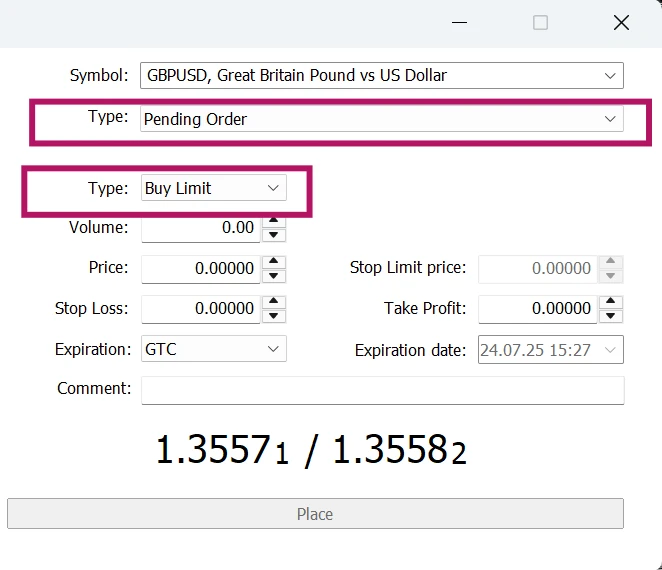
All of these platforms come in desktop, iOS, Android and browser versions, so traders can use them on any device. For example, the MT5 pending order types let traders preset the entry price, the stop loss and an expiry time.
Beyond the platforms, the broker has tools for people who do not trade themselves or who manage money. Copy Trading lets beginners copy the trades of experienced traders. MAM and PAMM are for those who manage several accounts at once or take other people's capital to trade on their behalf. This toolset usually appears only at mid-range brokers and above.
Tradable products
FISG offers six product groups, each with typical examples:
- Forex: EUR/USD, GBP/JPY, AUD/USD and other pairs;
- Metals: gold, silver, platinum;
- Indices: US30, NASDAQ, SP500;
- Energy: WTI and Brent crude;
- Shares: CFDs on Apple, Tesla, Google and others;
- Crypto: BTC, ETH, XRP, ADA and other coins.
This range may differ between entities and between regional sites. Traders should therefore open the "Markets" or "Account Type" section on the very site used to register to see exactly what is available.
Leverage by entity
Leverage is where the differences between entities show most clearly. FISG advertises three different levels depending on the site:
- 1:30 for clients of the CySEC entity, under the rules of the European Securities and Markets Authority (ESMA);
- 1:500, the level usually seen on the Vietnamese-language sites;
- 1:1000 to 1:2000 on some Thai and English-language pages.
In other words, the leverage a trader actually gets depends on the entity that accepted the application, not on the figure in an advert. How leverage affects the risk of blowing up an account is explained in forex leverage for beginners.
Deposits and withdrawals
According to the broker's promotional material, clients can deposit and withdraw through three channels: bank transfer (TT), UnionPay cards and cryptocurrencies such as USDT and BTC. Deposits are described as instant. Withdrawals, under the broker's policy, are processed within one business day.
However, actual timing also depends on the payment channel and the intermediary bank. The safe approach, then, is to withdraw a small test amount first, both to see the speed and to check how transparent the process is.
What users say
On Trustpilot, FISG receives many positive reviews, mostly from international users. Even so, public reviews can be influenced by marketing campaigns, and the identity of the writers usually cannot be verified. High scores on review sites should therefore be treated as a secondary signal only.
From the available feedback, three points emerge. First, few serious negative reports have been recorded about the broker. Second, transparency depends on the entity a client belongs to. Third, the contract and the licence are more reliable than any review, so traders should check those two first.
Risks to weigh
Although there are no serious complaints, FISG still carries three groups of risk that traders should account for before depositing.
Offshore entities offer little protection
Clients who open accounts under the Seychelles or St. Vincent entity have no ICF cover. They also lack European-standard leverage limits and an effective dispute resolution mechanism, so if something goes wrong they are largely on their own.
High leverage brings high risk
Leverage of 1:1000 or 1:2000 sounds attractive because little margin is needed to open a large position. However, the same ratio can wipe out an account very quickly when prices move the wrong way, unless the trader controls position size and stop losses.
The 2 million euro insurance is unverified
FISG claims to have 2 million euros of insurance from Lloyd's of London for clients of its CySEC and Seychelles entities. However, there is no public evidence that this insurance has been verified by an independent party. It is an internal policy of the broker, not part of any mandatory legal scheme, so traders should ask for the insurance certificate and the list of exclusions before relying on it.
Frequently asked questions
Is FISG licensed?
Yes, but it depends on the entity. The Cyprus entity holds CySEC licence 166/12. The Seychelles entity is licensed as a Securities Dealer, number SD127, with lower protection standards. The St. Vincent entity is only registered as a business and has no licence supervising CFD activity.
Can the 2 million euro insurance be trusted?
That cannot be confirmed yet. As noted above, it is an internal policy for CySEC and Seychelles clients, not a mandatory legal mechanism. Traders should therefore ask for the insurance certificate and read the exclusions before depositing.
Is FISG a scam?
There is currently no evidence that FISG is a scam. Even so, the complex entity structure means users need to check the legal details and level of protection themselves before signing up. Warning signs of a dubious broker are covered in six warning signs of a forex scam broker.
Is FISG suitable for Vietnamese traders?
The broker may suit three groups of people. These are traders with experience of offshore brokers, those who know how to manage risk with high leverage, and those willing to confirm their entity and test a withdrawal early.
By contrast, FISG does not suit two other groups. The first is new traders who need clear legal protection. The second is anyone who puts transparency and strict regulation first.
How can a trader tell which entity an account belongs to?
There are three checks, best used together:
- Look again at the website used to register the account.
- Read the "Legal" or "Terms & Conditions" section of the agreement carefully, where the name of the contracting company appears.
- Ask the broker's support team, or the introducing broker (IB) who referred the client, to confirm.
Conclusion
FISG is an international broker operating across several regions, with a clearly defined European entity under CySEC and international entities in Seychelles, Australia and St. Vincent. It has good technology, professional MT4 and MT5 platforms and a varied product range. However, the risk remains high for traders who do not know which entity they are trading under, because the rights offered by the European entity and the offshore ones differ greatly.
Sources
- FISG (Interstellar), official website, https://www.fisg.com/ — entities, platforms, products and payment policy; traders should confirm details there.
- Cyprus Securities and Exchange Commission (CySEC), https://www.cysec.gov.cy/
- Seychelles Financial Services Authority (FSA), https://fsaseychelles.sc/
- Australian Securities and Investments Commission (ASIC), https://asic.gov.au/
- Trustpilot, FISG review page (user opinions, unverified)
- Image: DCtoptrade (screenshot): https://dctoptrade.vn/