Forex Scam Brokers Flagged in Vietnam
15 forex brokers warned about, prosecuted or accused of fraud in Vietnam, five warning signs, what to do after depositing and how to avoid the wrong broker.

Every day the foreign exchange (forex) market turns over billions of dollars. A market that size attracts plenty of bad actors: alongside brokers that do honest business there are always brokers set up only to take clients' money. In Vietnam, the police have broken up scam broker rings and arrested their operators many times, yet detection remains hard because the methods keep getting more sophisticated.
The sections that follow gather what traders need to protect themselves: five common signs of a scam broker, a list of 15 names that were raided, prosecuted or warned about in Vietnam, what to do after a deposit has already been made, and how to choose a broker so that situation never arises. The list was compiled from public information up to 2023, so before drawing conclusions about any broker, traders should check the regulators' own warning lists.
Five signs of a scam broker
Scam brokers rarely reveal themselves straight away. On the contrary, they usually dress up as reputable firms, advertising low fees, high commissions and generous bonuses to lure newcomers or the trusting. However sophisticated they are, these brokers still differ from genuine ones in a few checkable ways. The five points below are the most common; a deeper analysis, with how to verify each point, is in six warning signs of a forex scam broker.
No licence
A licence from a major financial authority such as the FCA (UK), CySEC (Cyprus) or ASIC (Australia) is the clearest evidence that a broker can be trusted. These licences are not easy to obtain. The broker must hold minimum capital, have operated for a minimum period, keep client money separate from company money and file regular audit reports.
As a result, the lack of a proper licence is the clearest sign that a broker is unsafe. That said, being unlicensed is not the same as being a scam, since some brokers simply do not yet meet the conditions to apply. Even so, for peace of mind traders should still favour fully licensed brokers.
Some brokers go further and forge licences. Traders should therefore look the broker up on the regulator's website themselves, or click the licence link on the broker's home page and cross-check it. If the broker cannot be found in that regulator's register, it is certainly a scam.
Promises of huge profits
A broker that promotes managed trading, signal sales or robots with promises of high returns deserves suspicion. The reason lies in the nature of the market: forex always carries the risk of loss, so no person, robot or strategy can guarantee winning 100% of the time.
In Vietnam this kind of scam often runs through IBs (introducing brokers, people who refer clients to a broker). Many IBs of scam brokers use social media to build an image of a professional trader, showing off cash and houses and posting get-rich philosophies, all to draw others into depositing. The trick repeats constantly, so newcomers need to stay especially alert.
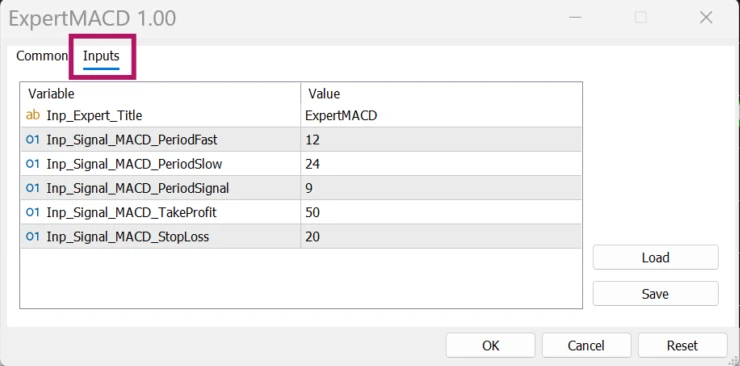
A trading robot (EA) is really just a program that places orders according to preset parameters, as the screenshot shows. It has no way of knowing the market in advance, so a promise of fixed profits attached to a robot is a promise that cannot be kept.
An unreliable trading system
The trading system directly affects the outcome of every order. A broker whose platform runs erratically, executes slowly, has poor liquidity and frequently breaks down is not a safe broker. When a fault hits just as prices move sharply, a trader can lose money simply because an order was not handled properly.
Opaque deposits and withdrawals
A reputable broker has a clear deposit and withdrawal process, handles requests quickly and usually pays out the same day. It also has a support team available 24/7 for funding questions. Scam brokers are entirely different: some ask clients to transfer money into a personal bank account, then freeze the trading account and refuse withdrawals. Being unable to withdraw is therefore the surest sign of a scam broker.
Negative feedback from traders
Before depositing, traders should read what is said about the broker in the press, on Google, Facebook, Twitter and mainstream news sites. Normally a good broker is praised by many people, while a scam broker collects plenty of complaints. However, some brokers compete dirty by paying people to write bad reviews of rivals. This sign alone is therefore not enough; traders need to weigh all five signs together for an accurate conclusion.
15 brokers flagged in Vietnam
The following list covers brokers recorded as having been raided, prosecuted, or showing signs of fraud in Vietnam, based on information compiled up to 2023. The status of each may have changed since then, so traders should treat this as a list to be wary of and verify further, not as a legal finding.
Multiply Markets
This broker was uncovered and raided for operating without a licence. In addition, it offered no demo account (a practice account with virtual money) and had no withdrawal process. Trading costs, including commission and spread (the gap between buy and sell prices), were extremely high.
GG Trade
GG Trade was raided for forging a licence from New Zealand's FMA. The broker lured traders into investment mandates, that is, handing money to someone else to trade on their behalf, in order to profit illegally. Its deposit and withdrawal policy was also unclear and showed many irregularities.
ECN Capital
ECN Capital was prosecuted after repeated fraud warnings from bodies including CySEC, FINMA and New Zealand's FMA. The broker published false information. On top of that, withdrawal fees were pushed far too high, and clients often could not withdraw at all.
Blue Trading
Blue Trading was warned about by the FCA several times. The broker made traders pay many extra fees that did not appear in its terms, which made withdrawing very difficult.
EU Capital
EU Capital likewise received repeated FCA warnings. The broker routinely widened spreads and held on to investors' money. It also pushed traders to make large initial margin deposits in order to trade big volumes.
OT Capital
OT Capital was flagged by ASIC for impersonation and regulatory breaches. According to complaints, traders at this broker could not withdraw their money.
GCE Capitals
GCE Capitals was regularly placed on FCA warning lists. The information it provided was opaque and unclear.
Liber Forex
Liber Forex forged an IFSC licence and operated as a Ponzi scheme, paying earlier investors with money from later ones. To attract investors it once promised returns of 16–20% a month. Vietnam's Ministry of Industry and Trade also issued a warning about it.
FXTrading Markets
FXTrading Markets impersonated the FXTM brand. It held investors' funds on the pretext of a "platform upgrade", ran on a binary options (BO) model and raised money through a multi-level marketing structure.
GCFX
GCFX was flagged as fraudulent by the Swiss bank Dukascopy. The broker forged licences from FINMA and the FCA and lured clients with returns of more than 200% a month, a figure no real market can sustain.
TradeFTM
TradeFTM's licence was inaccurate and of poor standing. Its IB approach was unprofessional and amounted to herding newcomers in en masse. The broker also demanded a very high initial deposit.
Novox
Novox charged very high fees, including many unreasonable ones. Its customer care was poor to the point of barely existing, while it offered few products and its system often failed.
GICC FX
GICC FX had no operating licence. It also drew many negative reviews alleging fraud and cheating.
Samtrade FX
Samtrade FX had no licence, very high costs and many unreasonable fees. There was no live support, and email support was very limited.
Bree Trade
Bree Trade had no operating licence. The information on its website was inaccurate and opaque, and it drew many negative reviews alleging fraud and cheating.
Taken together, these names repeat the same few patterns: no licence or a forged one, unreasonable fees, promises of high returns and difficulty withdrawing. Cases covered separately, such as BPS Capital, Dex Investing and KVB Prime, show the same signs.
After trading with a scam broker
A trader who has already deposited with one of the brokers above should not panic. Instead, four steps are worth following, in order of priority.
Stop depositing
As soon as a broker shows signs of fraud, such as murky funding or blocked withdrawals, not another cent should be sent. In urgent cases, traders can report the broker's refusal to pay out to the police or local authorities. Money already lost may be hard to recover, but stopping deposits at least prevents further losses.
Do not chase losses
The urge to win money back and the fear of losing it are exactly the weaknesses scam brokers target. Typically, when a trader loses, the broker or IB suggests depositing more to "help recover the capital". In reality, that is just a way to take more of the client's money. Once fraud has been spotted, traders should stop trading at once and drop any idea of winning it back.
Accept it and withdraw what is left
Once it is clear the broker is a scam, traders should accept the situation, close all positions and withdraw funds as soon as possible. This will not save everything, but it can preserve part of the capital.
Share the story so others avoid it
Finally, traders should describe the broker's tricks so that the next person does not become its next "prey". Channels can include social media, the press or simply word of mouth. Each specific warning helps one more person stop before depositing.
How to avoid choosing the wrong broker
Prevention beats cure, and the five criteria below help traders screen a broker before opening an account. None is reliable on its own, so they should be weighed together.
Time in business
The forex market is fiercely competitive, so scam brokers struggle to last and are usually weeded out quickly. A broker that has operated for many years is therefore more trustworthy than a newly founded one. However, some scam brokers lie about their founding year, so this criterion needs checking alongside the others.
Licensing
As noted in the warning signs, a forex licence is hard to obtain because many conditions must be met. Traders should therefore look closely at the licence, its number and the issuing body, then cross-check it on that body's website. The licences regarded as most reliable include the NFA (United States), FCA (United Kingdom), ASIC (Australia), FINMA (Switzerland), FSA (Japan) and CySEC (Cyprus).
Deposit and withdrawal speed
At a reputable broker, deposits and withdrawals are usually processed within 1 to 24 hours. Scam brokers, by contrast, often let withdrawals drag on for more than a day. Even so, traders should read the funding policy carefully, because some good brokers use international transfers that take longer. Beyond speed, withdrawal fees and whether support staff respond quickly and in time are also worth checking. The cost of each trade, the part most easily hidden, is explained in spread vs commission.
Asking experienced traders
Before picking a broker, it pays to ask people who have traded for years. A broker used by many professional traders is a fairly good guarantee of safety. Such opinions can be found on forums, social media or at offline meet-ups.
Relying on official information
Scam brokers often declare false information, forge documents and avoid official sources in order to fool newcomers. Traders should therefore take information from the original source, such as the regulator's register or the broker's official website, and weigh all five criteria before deciding whether a broker is a scam.
Conclusion
In forex, choosing a good, reputable broker is the first condition for trading over the long run. Knowing the signs of a scam broker, stopping at the right moment after a misstep and making a habit of checking before depositing will spare traders most of the risk of losing money to the wrong broker.
Sources
- FCA, Financial Services Register: https://register.fca.org.uk/
- CySEC, list of regulated entities and warnings: https://www.cysec.gov.cy/
- ASIC, search tools: https://asic.gov.au/
- NFA, BASIC search system: https://www.nfa.futures.org/BasicNet/
- FINMA, warning list: https://www.finma.ch/
- DCtoptrade (screenshots): https://dctoptrade.vn/