What Is an MIB in Forex
An MIB (Master IB) sits above an IB and earns commission from a whole network of sub-IBs. How it differs from an IB, where its income comes from and who fits.
Most forex traders have heard of the IB, the person who refers clients to a broker and is paid commission based on the volume those clients trade. Fewer notice that above many IBs sits another partner tier, one that clients rarely see but that plays a large part in how brokers expand into new markets. That tier is called the MIB, short for Master Introducing Broker.
The basic mechanics of an IB, from referral links and tracking codes to how commission is calculated, are explained in what is an IB in forex. The sections that follow build on that foundation: who an MIB is, how an MIB differs from an ordinary IB in role, rewards and responsibilities, where an MIB's income comes from, and who should genuinely consider the role.
Who an MIB is
An MIB is the tier above an IB in a forex broker's partner structure. Where an IB brings clients to the broker and earns commission on those clients' trades, an MIB stands behind many IBs at once. An MIB can be pictured as a regional distributor: it recruits and develops sub-IBs and, through them, builds an entire network of traders.
For that reason, an MIB's work is much broader than inviting clients. MIBs can still refer clients directly, but the difference is that they are entitled to recruit and manage sub-IBs while also earning extra commission on the trading volume of that whole network. In other words, the MIB lays the groundwork: setting up distribution, training new IBs, supporting them and growing the broker's business in the market it covers.
Some people even compare an MIB to a broker's exclusive agent in a region, especially when the MIB is able to open an office, hold seminars and offer technical support to the community. In many cases the MIB also acts as an adviser to sub-IBs on the market and on working methods, with the aim of lifting each IB's results and keeping the network from falling apart.
From this, the core difference between the two roles can be put in two points:
- an IB earns mainly from the group of clients it referred personally;
- an MIB earns from both its direct clients and the entire IB network it has built.
These two points are only the broad picture. To see the difference more clearly, the two roles need to be compared aspect by aspect.
How an MIB differs from an IB
In broker partner programmes, the IB is the most common tier, and almost anyone with clients and the ability to refer them can sign up. Moving into the MIB role changes the nature of the work: the partner is no longer just earning commission from clients but building and running an entire IB system. The difference shows in three areas.
Role and operating model
An ordinary IB focuses on bringing clients directly to the broker, so its income depends entirely on that group's trading volume. By contrast, an MIB builds a layer of sub-IBs, sometimes a few dozen and sometimes several hundred people, and earns commission from both individual clients and that whole network.
Thanks to this structure, an MIB does not necessarily need to refer many clients itself. Its income comes from the combined volume of the entire system, so it is usually steadier than that of a single IB.
Rewards and commission
For an IB, the commission (rebate) on each client lot is usually a fixed rate set by the broker's policy. An MIB typically enjoys considerably more, specifically:
- a higher rebate per lot than an IB;
- a percentage of commission from every sub-IB, split by tier or by whatever flexible arrangement the broker allows;
- support from the broker such as a marketing budget, materials, funding for in-person seminars and events.
These three rewards explain why many experienced IBs aim to become MIBs. Even so, each broker sets its own rates and split rules, so the actual figures only appear in each broker's partner agreement.
Responsibilities and skills
An IB can work alone without anyone's help. An MIB is different because it is responsible for an entire network of people, and it usually needs:
- the ability to organise, train and lead the network;
- business, communication and financial management skills;
- in some cases, its own support team, a representative office or its own customer relationship management (CRM) software.
If an IB is likened to a retailer, an MIB is the one building the distribution network. Once that network runs smoothly, it almost operates itself and generates passive income over time.
Where an MIB's income comes from
Becoming an MIB is not simply a matter of earning more commission; it is a shift from brokering to a systematic business model. By learning to build an IB network, manage clients and coordinate strategy with the broker, an MIB can create a lasting passive income with plenty of room to grow. That income comes from four main directions.
Multi-tier commission
Unlike an IB, which only earns from direct clients, an MIB also receives a share from every sub-IB. This tiered split means an MIB's income can grow very quickly if the network expands steadily.
For example, suppose an MIB has 20 sub-IBs, each with 20 clients trading regularly, and each client trades 5 lots a month. The whole system then generates 20 × 20 × 5 = 2,000 lots a month. With that volume, the MIB could earn thousands of USD a month without personally referring a single extra trade, although the exact figure depends on the per-lot share the broker applies.
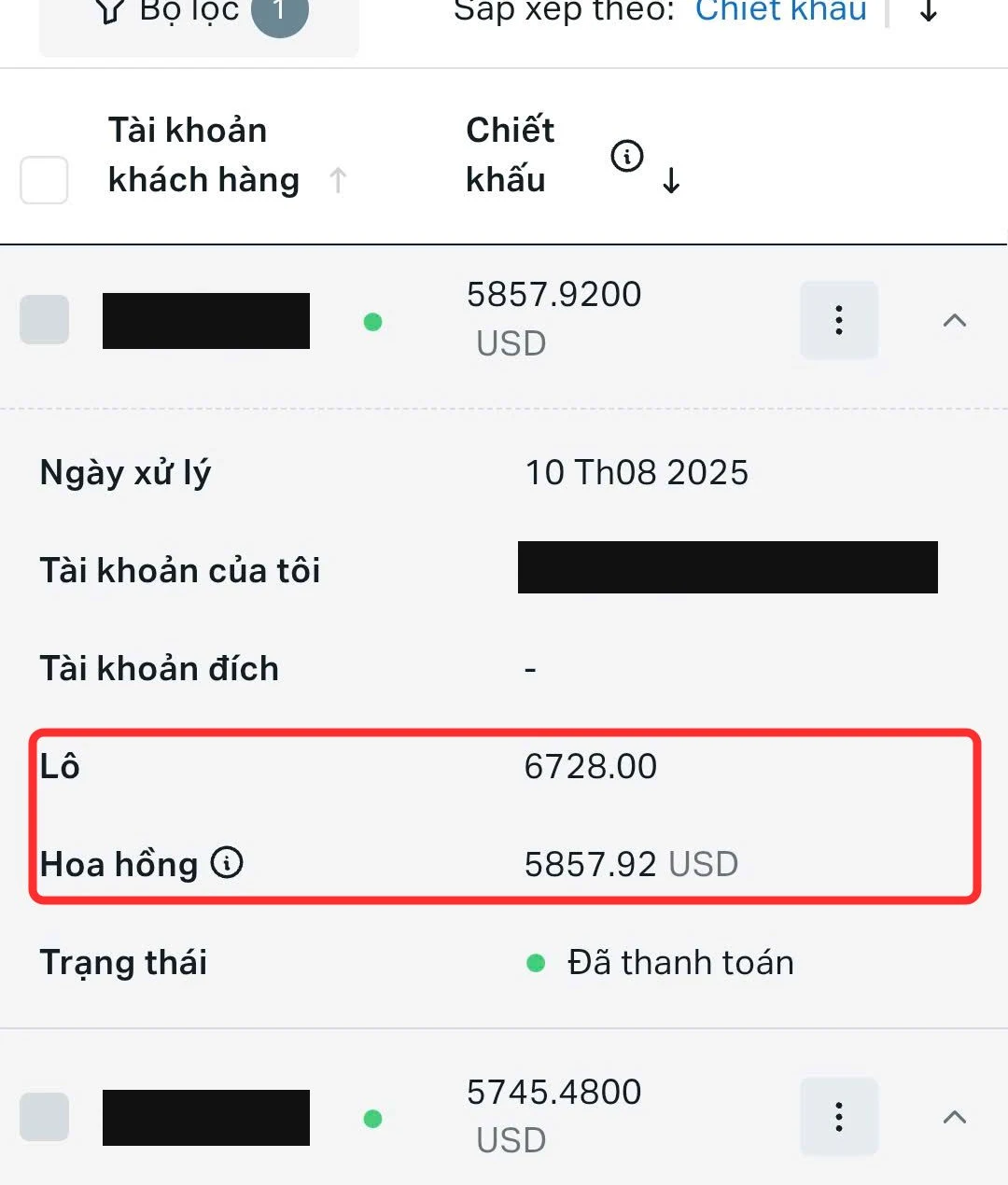
The image shows a real commission table in the Exness partner area, with 6,728 lots producing 5,857.92 USD. Dividing one by the other gives an average of less than 1 USD per lot, so anyone planning an MIB business should estimate with the broker's real split rather than assume a high figure.
Negotiating power and broker support
MIBs can usually negotiate more flexible rebate rates than IBs. They may also receive marketing support, event budgets and client gifts, or be assigned to manage a particular geographic region or market segment.

Industry events like the one pictured are where brokers meet partners and present new policies, and MIBs are often invited or sponsored to run similar sessions in their own markets. In addition, some brokers provide a dedicated network dashboard, volume statistics software and CRM tools. As a result, an MIB can track its network the way a company manages its branches.
A personal or company brand
An MIB can open a representative office, launch a website and build its own brand, for instance a name along the lines of "ABC FX Partners". From there it can start training channels, community groups or investment support services. This approach makes the MIB less dependent on short-term income and gradually gives it an ecosystem of its own, spanning advice, training and trading support.
No large capital and no market risk
Unlike trading on its own account, an MIB does not face price swings, margin calls or losing capital on bad trades directly. For that reason, the role is seen as one of the more durable ways to earn from forex without placing trades every day. Even so, an MIB's income remains tied to the broker's policy, and risks such as a broker cutting commission or losing its reputation are discussed in the IB article mentioned at the start.
Taken together, these four directions make the difference between the two roles clear. An IB needs clients to earn, whereas an MIB builds a system so that money flows in by itself, which means an MIB's income comes from the structure it creates rather than only from daily effort.
Who should become an MIB
Not everyone should, or needs to, become an MIB. The role suits people who think in terms of systems, meaning they want not only to earn from trading but to build their own forex business around a team and a personal brand.
People suited to the MIB role usually share four traits:
- several years of experience as an IB, with a clear grasp of how brokers operate and how rebates are split;
- the ability to connect, train and build a team, whether online or in person;
- a wish to develop a personal brand, such as a Telegram channel, fan page, community group or IB office;
- persistence and a long-term view, accepting that building a system takes time, trust and stamina.
On the other hand, four groups are not ready for the role yet:
- newcomers to the market who have no clients and have never recruited an IB;
- people who dislike managing teams and do not enjoy communicating or training;
- people who expect an MIB role to pay off immediately and are not prepared for an early phase that earns almost nothing;
- people who have not worked out what value they bring beyond inviting clients.
A practical threshold is when an IB already has around 10–20 regularly trading clients, one or two people who want to follow them into IB work, and some experience advising or sharing knowledge with others. At that point, building an MIB model starts to make sense. If the goal is only an extra few hundred USD a month, however, doing the IB role well comes first, since there is no need to move up before the foundations are solid.
Key takeaways
Being an MIB means no longer working alone. An MIB leads a team, builds a community and is accountable for its network, but in return gains control, passive income and long-term recognition in the industry. Working as an IB can still pay, while the MIB path is for those who want influence, a system of their own and a long career in forex. For many, that is not a step for today but a destination after a period of solid IB work. Traders who use an account through an IB and want to understand the rebate they might receive back can read what is backcom.
Sources
- Exness, official website (partner area): https://www.exness.com/
- Vantage, official website: https://www.vantagemarkets.com/
- DCtoptrade (screenshots): https://dctoptrade.vn/