
HFM Review 2026
HFM review 2026: group entities and licences, six account types, spreads and commission, leverage, MT4, MT5, Copy Trading, withdrawals and fund safety.
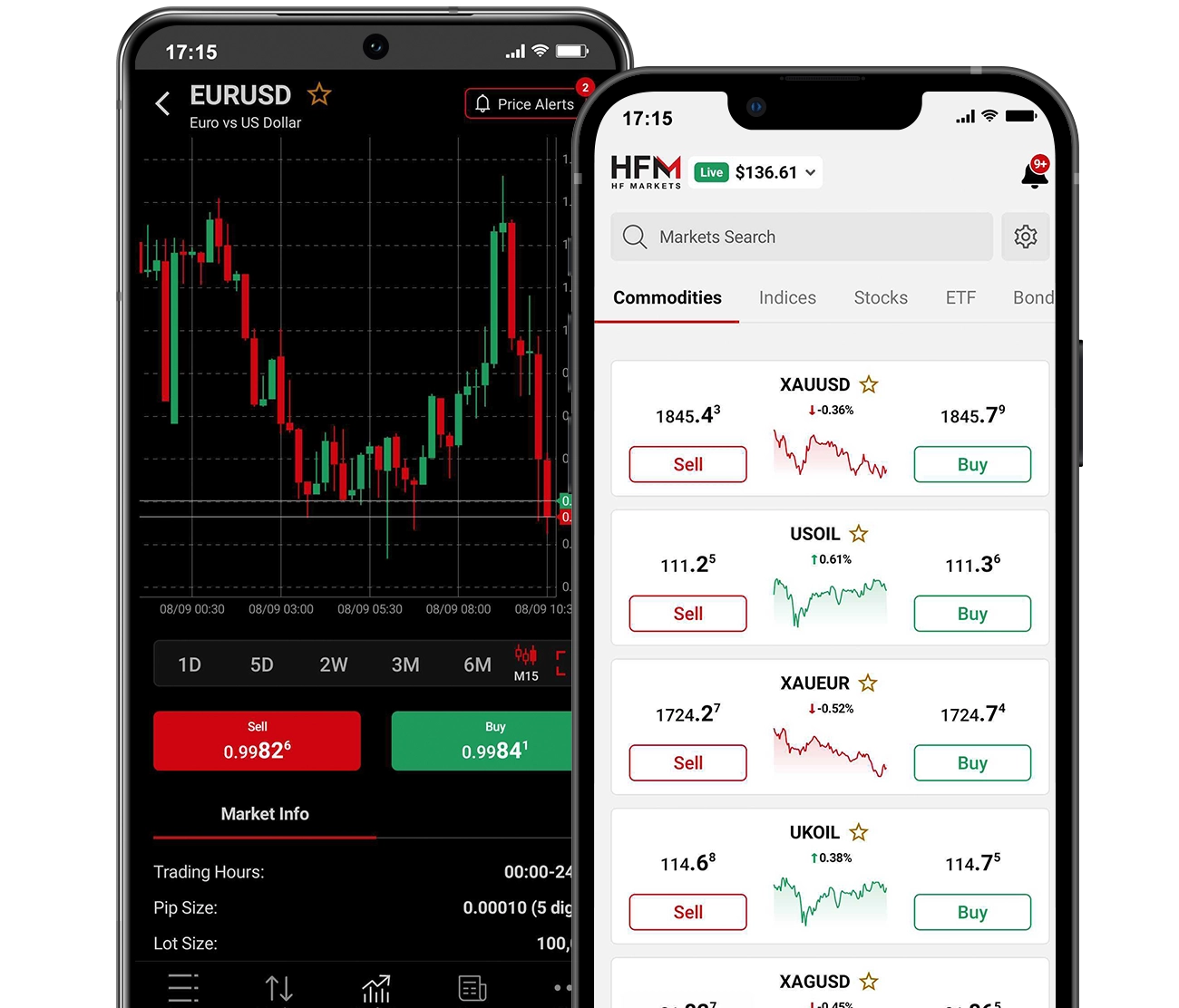
HFM is an international forex and CFD broker founded in 2010. Many Vietnamese traders still know it by its former name, HotForex, because the brand only switched to HFM in May 2022. The reason for the change is easy to see: the broker had expanded well beyond currencies, so a name tied so closely to the word "Forex" no longer described the business accurately.
Three things keep HFM in the conversation: a wide range of account types, very high leverage and a full tool set covering MT4, MT5, WebTrader, a mobile app and Copy Trading. The sections that follow cover the group's entities and licences, what can be traded, the six account types, the cost of a trade, platforms, deposits and withdrawals, how client money is protected, and finally strengths, weaknesses and the traders the broker suits. Fees, spreads and leverage can change over time, so traders should check current conditions on HFM's official website before opening an account.
Profile at a glance
Before looking at each area, the table gathers the basic facts to give a quick picture of the broker:
| Item | Detail |
|---|---|
| Current name | HFM (HotForex before 05/2022) |
| Founded | 2010 |
| Business model | Multi-asset CFD broker, including forex |
| Notable regulators | FCA (UK), CySEC (Cyprus), FSCA (South Africa), FSA (Seychelles), CMA (Kenya) |
| Tradable assets | Currencies, gold and other metals, oil and energy, indices, shares, commodities, bonds, ETFs, crypto |
| Range | More than 500 markets |
| Accounts | Cent, Premium, Pro, Zero, InfinityX, Top-Up Bonus |
| Lowest starting spread | 0 pips, on the Zero account |
| Leverage | Up to 1:2000 on most accounts; no cap on InfinityX |
| Software | HFM App, HFM WebTrader, MT5, MT4 |
| Copy trading, demo, Vietnamese support | All three available |
Each row only means something once it is tied to the specific entity and account type a trader uses. The next section therefore starts with the most important question: which company actually holds the account.
Licences and group entities
HFM is not a single company but a shared brand used by several companies within HF Markets Group. Each subsidiary, or legal entity, serves its own region and is supervised by the regulator where it is registered. As a result, two traders who both open HFM accounts can be protected to different degrees, depending on which company is named in their contract.
The group's six main entities, listed by location, are:
- United Kingdom: HF Markets (UK) Limited;
- Cyprus: HF Markets (Europe) Ltd;
- South Africa: HF Markets SA (PTY) Ltd;
- Seychelles: HF Markets (Seychelles) Ltd;
- Kenya: HFM Investments Ltd;
- St. Vincent & the Grenadines: HF Markets (SV) Ltd.
In Europe, the UK company appears on the register of the Financial Conduct Authority (FCA) under reference 801701. The Cyprus company, with its office in Larnaca, received licence 183/12 from the Cyprus Securities and Exchange Commission (CySEC) on 20 November 2012.
For the other regions, licence 46632 was issued by South Africa's FSCA to the company there. The Seychelles company holds Securities Dealer licence SD015, while the Kenyan company carries licence 155 from Kenya's Capital Markets Authority (CMA). The St. Vincent & the Grenadines entity comes with no licence number in this information, so traders placed with that company should check carefully on the broker's website.
What can be traded
HFM's range spans many asset classes, but almost everything is offered as a CFD. A CFD, or contract for difference, is a contract where the buyer never owns the underlying asset and simply gains or loses as the price moves. Thanks to this structure, a single account is enough to trade many different markets without owning any of them.
Currencies
Forex remains the broker's core business. Traders get major pairs such as EUR/USD, crosses that do not include the US dollar and a handful of exotic pairs from smaller economies. Zero, Pro and Premium all offer this market; Cent also has more than 50 pairs, the difference being that each contract is far smaller than on a regular account.
Metals
Gold is the standout in the metals group, because almost every account type can trade it, Cent included. Alongside gold, the broker offers several other metals.
Energy and commodities
This group covers crude oil, other energy products, plus hard commodities such as industrial metals and soft commodities such as agricultural goods. Each symbol has its own spread, trading hours and contract size, so traders should check the symbol's specification before placing an order.
Indices and shares
The broker offers CFDs on major stock indices and on shares of many international companies. With share CFDs, traders profit or lose on the price alone and never become owners of the actual shares.
ETFs and bonds
Adding ETFs and bonds is what makes HFM broader than brokers that stop at currencies, gold and indices. However, some products in these two groups only appear on MT5, WebTrader or the HFM App, not on MT4.
Crypto
HFM also offers crypto trading in CFD form. This means traders speculate on the price rather than buying actual coins, so they cannot move coins out to a personal blockchain wallet.
Six account types
HFM currently offers six options: Cent, Premium, Pro, Zero, InfinityX and Top-Up Bonus. What they share is market execution and a minimum trade size of 0.01 lot. They differ in spread, commission, leverage, initial deposit and two margin thresholds.
Those thresholds are worth understanding before reading the specifications. Margin Call is the level at which the broker warns that the account is running short of margin, while Stop Out is the level at which the broker starts closing positions automatically to limit further loss. Both are measured as the ratio between current equity and the margin tied up in open positions.
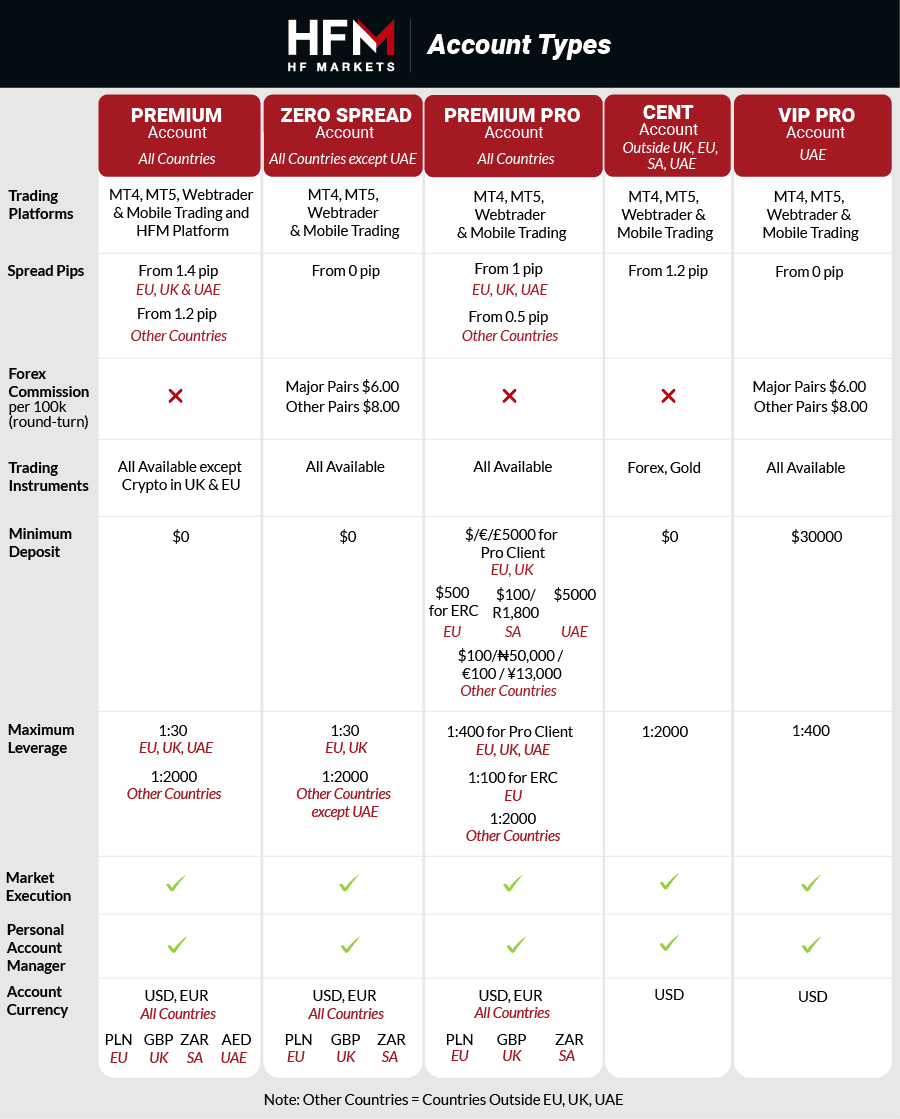
The screenshot shows the names Premium, Zero Spread, Premium Pro, Cent and VIP Pro, which do not fully match the six accounts discussed here. Traders should therefore treat the image as a reference for the interface only and check the current list on HFM's website.
InfinityX
InfinityX targets traders who want extremely high leverage. Opening one requires a deposit of at least 500 USD; in return, leverage has no cap, subject to the broker's conditions. Spreads start at 0.3 pips and the core structure charges no commission. The broker issues a margin warning at 20% and only closes positions at 0%. Products available on this account are currencies, metals, energy, indices and crypto.
It is the leverage and the 0% Stop Out that set InfinityX apart from the other five. Very little margin is needed, so traders can open large positions, but for the same reason equity swings far more sharply whenever the price turns.
Cent
On Cent, one lot equals only 1,000 units, or one hundredth of a regular lot. The account needs no initial deposit, charges no commission and offers leverage up to 1:2000. Spreads start at 1.4 pips. Traders can trade currencies and gold, hold at most 150 open positions at once, with a warning level of 50% and a stop-out level of 20%.
Balances are shown in USC, US cents, so a 100 USD deposit appears as 10,000 USC. This lets traders place very small trades, gradually getting used to real-money gains and losses while keeping the risk on each trade low.
Zero
Zero is a raw spread account, meaning spreads close to interbank prices, with commission charged separately in return. On some currency pairs the spread can drop to 0 pips. Each lot here is 100,000 units, maximum leverage is 1:2000 and every product the broker offers can be traded.
The commission needs a careful read. On currencies, the broker charges from 3 USD per lot on each side, so opening and then closing a trade costs 6 USD. On gold, a full round of opening and closing 100 ounces costs 10 USD. The warning and stop-out levels are 50% and 20% respectively.
This kind of account suits strategies that are very sensitive to spreads, such as scalping (trades lasting a few minutes) or trading robots. To find out what a trade costs, traders add the actual spread at entry to the commission.
Pro
Pro has low spreads, starting at 0.6 pips, yet most products carry no separate commission. Opening it requires a deposit from 100 USD or 100 EUR. Maximum leverage is 1:2000, each position is capped at 60 lots and total open positions at 500. The two margin levels are again 50% and 20%.
Pro can be placed between Zero and Premium. Compared with Premium its spreads are tighter; compared with Zero its pricing is simpler, because on most products there is no commission to add.
Premium
Premium is HFM's standard account. It needs no initial deposit, has no commission in its core structure, and spreads start at 1.4 pips. Traders get leverage up to 1:2000 and access to the full product range. The limits match Pro: 60 lots per position, 500 open positions at once, a warning at 50% and stop-out at 20%.
Because nearly all of the cost sits in the spread, Premium is easy to track for manual traders or anyone who prefers not to use raw spreads. Looking at the gap between the buy and sell price is enough to know what a trade costs.
Top-Up Bonus
Top-Up Bonus is an account linked to a deposit bonus scheme. Leverage here is lower than on the other accounts, at most 1:1000, and spreads start at 1.4 pips. The account requires no opening amount, charges no commission in its core structure, accepts trades from 0.01 lot and uses the same 50% and 20% levels.
That said, not every region can join the bonus scheme. How bonus credit is applied, the withdrawal conditions and the conditions for keeping the bonus all follow the scheme's own terms, so traders need to read them carefully before depositing.
The six accounts side by side
The table puts criteria in rows and accounts in columns, so the differences are visible at a glance:
| Criterion | Cent | Premium | Pro | Zero | InfinityX | Top-Up Bonus |
|---|---|---|---|---|---|---|
| Starting spread | 1.4 pips | 1.4 pips | 0.6 pips | 0 pips (forex) | 0.3 pips | 1.4 pips |
| Initial deposit | 0 USD | 0 USD | 100 USD/EUR | 0 USD per account table | 500 USD | 0 USD |
| Maximum leverage | 1:2000 | 1:2000 | 1:2000 | 1:2000 | No cap | 1:1000 |
| Commission | None | None | None | From 3 USD/lot per side | None | None |
| Suits | Newcomers, small capital, strategy testing | Everyday trading | Tight spreads, simple pricing | Scalping, EAs, short-term trades | High-leverage traders | Deposit bonus seekers |
Note that every spread figure in the table is only the minimum. HFM uses floating spreads, so the real gap varies by symbol, market depth and time of day.
What a trade costs
The cost of a trade at HFM comes from the spread, commission and overnight fees, while leverage determines position size and therefore the size of gains and losses. Each factor works in a different way.
Spread
The spread, the gap between the buy and sell price, is paid the moment a trade opens. Zero is the lowest at 0 pips on currencies. Next come InfinityX at 0.3 pips and Pro at 0.6 pips, while Cent, Premium and Top-Up Bonus all start at 1.4 pips. When markets jolt, liquidity thins or major economic news hits, spreads can widen considerably.
Commission
Commission is a fixed charge per lot on top of the spread. It is most visible on Zero, at 6 USD for a full round on one lot of currency and 10 USD for 100 ounces of gold. By contrast, the core structure of Cent, Premium, Pro and InfinityX has no such charge, although a few individual products may follow a separate fee schedule.
Overnight fees
Overnight fees, or swaps, arise when a position is held into the next session. HFM offers swap-free conditions on certain designated products. However, these do not apply to every symbol automatically and instead follow their own set of terms.
Leverage
Leverage lets traders open positions many times larger than the margin they put up. At HFM, Cent, Premium, Pro and Zero go up to 1:2000, Top-Up Bonus offers 1:1000 and InfinityX removes the cap entirely.
The key point is that leverage only reduces the margin required; the true value of the position stays the same. A large trade gains or loses on its full volume, so the higher the leverage, the harder a small price move hits the account. The principle is explained in more depth in forex leverage for beginners, and how to compare spreads with commission is covered in spread vs commission.
Trading platforms
HFM traders have four places to trade: the web browser, two MetaTrader programs and the broker's own mobile app. A copy trading system also runs across these platforms.
HFM WebTrader
The web version runs straight in the browser with nothing to install and uses TradingView charts. Users get 17 chart types, more than 80 drawing and analysis tools, more than 100 technical indicators and 9 timeframes. Both MT4 and MT5 accounts can log in here, and orders, alerts and actions are synchronised across devices.
MetaTrader 4
MT4 suits traditional forex traders, especially those using EAs (Expert Advisors, trading robots) and indicators written in MQL4. According to the broker's platform comparison, HFM's MT4 has 30 technical indicators, 31 analysis tools, 9 timeframes and 4 pending order types, and it runs EAs on desktop.
MetaTrader 5
MT5 is built for multiple asset classes and has more features than MT4. It offers 21 timeframes, 38 technical indicators, 44 analysis tools and 6 pending order types, plus a built-in economic calendar and support for EAs on desktop.
ETFs and DMA (direct market access) are available on MT5, WebTrader and the HFM App, but MT4 does not carry the full set. Anyone wanting to trade these products should therefore choose MT5 from the start.
HFM App
The broker's app is available for Android and iOS. On a phone, users can manage several accounts at once, place trades, view history, deposit, withdraw and follow prices. The app suits traders who want to do everything in one place instead of switching back and forth between the account area and MetaTrader.
Copy trading
HFM's Copy Trading has two roles:
- Strategy Provider, a trader who follows their own strategy and lets others follow along;
- Follower, a trader who picks a Strategy Provider and copies their trades.
Once connected, the Strategy Provider's trades are copied to the Follower's account almost instantly. Even so, Followers still manage their own capital, can stop copying at any time and keep full control of their account. To help choose whom to follow, the list shows growth, drawdown (the largest fall in equity), a risk score, the number of followers and the performance fee. The feature works on MT4, MT5 and the HFM App.
Deposits and withdrawals
To deposit, traders can use cards, bank transfer or other alternative payment channels, depending on where they live. HFM charges no deposit fee on the listed channels, although each channel has its own limits and processing time.
On the withdrawal side, a few points are worth knowing:
- some methods set a minimum withdrawal of 5 or 10 USD;
- alternative channels outside cards and banks usually process instantly or within a day;
- money back to a card can take 2 to 10 business days, and international bank transfers can take just as long;
- the broker charges no withdrawal fee, but intermediary banks may deduct a fee on transfers.
How quickly money arrives therefore depends mainly on the channel chosen. Traders who need funds urgently should favour those alternative channels, while those withdrawing by bank should allow a few days and the possibility of intermediary fees.
How client money is protected
On its fund safety page, HFM lists four layers of protection:
- Segregated client money: client funds are kept in separate accounts, not mixed with the company's operating capital.
- 5 million EUR liability insurance: cover for risks such as fraud, errors and certain other obligations of the company towards clients.
- Negative balance protection: if an account falls below zero, the broker brings it back to zero under its current policy.
- Stop Out: when the margin level reaches the account's set threshold, the system closes positions automatically.
The 5 million EUR figure needs to be read correctly. It is the size of the liability insurance programme, not compensation for trades lost because the price moved the wrong way. In other words, market losses remain entirely the trader's own.
Strengths
Drawing the sections together, HFM has five clear strengths:
- Accounts separated by need: Cent, Premium, Pro and Zero each serve a distinct purpose, so traders choose by capital and pricing model rather than agonising over two near-identical options.
- A full platform line-up: MT4, MT5, a web version and a dedicated app are all available; EA users get MetaTrader, while those who like modern charts get the web version with TradingView.
- A large range: more than 500 markets, from currencies, gold, oil, shares and indices through to ETFs and bonds.
- Room for small capital: Cent's 1,000-unit contract makes testing a strategy with real money far more flexible than on a regular account.
- Plenty of extra tools: besides copy trading there is Autochartist, VPS, an economic calendar, trading calculators and learning material, all within one ecosystem.
Weaknesses
On the other hand, there are five points traders should weigh up:
- Many entities, easy to confuse: one HFM name, but protection depends on the company in the contract and is not the same for every client.
- Very high leverage: 1:2000 and InfinityX's uncapped model mean very little margin is needed, so with large trades the account reacts sharply to every price move.
- Standard-account spreads are not cheap: Premium starts at 1.4 pips, so cost-conscious traders will need to look at Pro or Zero.
- No cTrader: the broker offers only MetaTrader, the web version and its own app, so cTrader users will not find their platform.
- Uneven withdrawal speed: some channels are quick, but cards and bank transfers can take several business days.
Who HFM suits
From those strengths and weaknesses, the trader groups that fit HFM are:
- Traders leaving a demo account: Cent has small contracts and no minimum deposit, making it suitable for getting used to the psychology of real-money trading.
- Short-term traders: Zero offers spreads from 0 pips with commission per lot; those who want tight spreads without a separate commission have Pro.
- Robot users: the combination of MT4, MT5, VPS and the Zero account creates a convenient environment for EAs and automated systems.
- Traders who want to copy strategies: Copy Trading lets them pick a Strategy Provider and manage their capital within the system.
- Multi-asset traders: Pro, Premium and Zero cover currencies, shares, ETFs, bonds and crypto CFDs alike.
Conversely, traders who prefer cTrader or want to trade with low leverage may find HFM a poor fit. The broker has no cTrader, and most accounts are designed around very high leverage, two traits that may not match some trading styles.
Frequently asked questions
Can HFM spreads go down to 0 pips?
Yes, on the Zero account. On suitable currency pairs the spread can drop to 0 pips, and in return the trader pays commission from 3 USD per lot on each side.
Does HFM offer copy trading?
Yes. Users can join as a Follower to copy trades or as a Strategy Provider to share a strategy.
Can an HFM account go negative?
Traders do not have to cover a negative balance. If the balance falls below zero, the broker brings it back to zero under its negative balance protection policy.
Does BackcomHub offer rebates at HFM?
BackcomHub currently has no rebate programme with HFM. Interested traders can read how rebates work in what is backcom, or see the rates at brokers BackcomHub tracks, such as Vantage and Exness.
Verdict
HFM is a long-established forex and CFD broker with a broad range and an account line-up cut to many different needs. Overall, it suits traders who want plenty of account choices, flexible leverage and MetaTrader, and who need to trade many kinds of CFDs.
On cost, Pro and Zero are the two most notable options, while Cent is the distinctive choice for those who want to start small. Whatever the account, traders should still check which entity holds their account, keep leverage at a sensible level and compare the latest conditions on HFM's official website.
Sources
- HFM, official website (entities, account conditions, platforms, deposits and withdrawals, fund safety): https://www.hfm.com/
- Financial Conduct Authority (FCA), Financial Services Register, reference 801701: https://register.fca.org.uk/
- Cyprus Securities and Exchange Commission (CySEC), licence 183/12: https://www.cysec.gov.cy/
- Financial Sector Conduct Authority (FSCA), South Africa, licence 46632: https://www.fsca.co.za/
- Capital Markets Authority (CMA), Kenya, licence 155: https://www.cma.or.ke/
- DCtoptrade (screenshot): https://dctoptrade.vn/


