
Low-Cost Forex Brokers 2026
How to add up the real cost of a forex trade (spread, commission, swap), the cost of one EUR/USD lot at Exness, IC Markets and XM, and how rebates cut it.
When choosing a first broker, every trader wants to pay as little as possible, because each dollar of fees is a dollar taken out of profit. The catch is that "cheap" in forex is not found in an advert for low spreads or zero commission. Traders who misunderstand how costs add up can easily pick the wrong broker and watch their account wear down over time, especially if they trade often.
The sections below break down each fee a trader pays, show when a broker is genuinely cheap for each trading style, compare the total cost of one EUR/USD lot at Exness, IC Markets and XM, and then recalculate that figure after the rebate is deducted. Every calculation uses public figures, so traders can repeat it for their own broker.
The fees traders pay
Every forex trade can carry four kinds of cost:
- The spread, the gap between the buy and sell price.
- Commission, a fee some account types charge per lot.
- Overnight financing (swap), charged when a position is held into the next trading day.
- Indirect costs, which arise when an order slips or fills less than optimally.
How much each one matters depends on trading style. The same broker can therefore be cheap for one trader and expensive for another.
A low spread is not always cheap
Many brokers advertise ultra-low spreads, some from 0.0 pips. That figure, however, does not mean a low total cost, for three reasons:
- A low spread usually comes with a commission.
- The spread can widen at certain times.
- Hidden costs such as slippage can push the real cost above expectations.
To find out which broker is cheap, traders therefore have to look at the total cost of the whole trade rather than a single number. Only that total shows what each trade really costs.
Four common misconceptions
Traders hunting for a cheap broker tend to stumble over four misconceptions:
- Looking only at the minimum spread and ignoring the average spread.
- Forgetting to add commission when comparing.
- Believing that a commission-free broker is always cheaper.
- Not matching costs to their own trading style.
As a result, many traders choose a broker that looks cheap but does not fit, and only notice after paying fees for a while. The following sections help avoid each misconception by looking at every fee in turn.
How each fee eats into profit
Spread
The spread is paid the moment a position opens. The wider it is, the farther away the break-even point, meaning the price has to travel further before the trade starts to make money. The figure to check is therefore the average spread during real trading hours, not the lowest one in the advert.
Commission
Commission is usually charged per lot. For traders who place many orders or trade large volume, it can become the main cost, even larger than the spread. Traders should therefore add up a day's or a week's commission to see how big it really is.
Overnight swap
Swap hits traders very differently depending on how long they hold positions. Day traders barely pay it, while traders who hold for several days (swing traders) can lose a significant share of profit to it. Judging whether a broker is cheap therefore depends on the kind of trades a trader usually opens.
Cheap for whom
A broker is cheap for scalpers (who open and close trades within minutes) when the spread is low and stable, the commission is clear and the total cost per trade is small. The reason is that scalpers open so many trades that even a small fee difference multiplies into a large sum.
For traders who place few orders, by contrast, a stable spread matters more than an ultra-low one. Low-commission or commission-free accounts make costs easy to calculate, so a commission-free broker can sometimes be the better fit.
For traders with small accounts, a cheap broker is one whose costs do not gnaw away at the balance, that does not require large volume just to "earn back" fees, and whose conditions are clear and easy to understand. If costs are too high relative to capital, the account will struggle to survive.
Three numbers to compare
When placing brokers side by side, traders need exactly three numbers. The first is the average spread on popular pairs, along with how stable it stays during the main sessions. The second is commission measured per round-turn (opening and closing a trade), on the same volume so the comparison is fair.
The third, and decisive, number is the total cost per lot, which equals spread plus commission. To convert spread into money, traders use pip value: on EUR/USD one pip on a standard lot is worth 10 USD, so a 0.8-pip spread equals 8 USD. More worked examples are in lots, pips and pip value and spread vs commission.
Costs at Exness, IC Markets and XM
The three brokers below come up often in discussions of low costs. Spreads and commissions can change, so traders should check the current terms on each broker's official website before opening an account.
Exness
Exness offers many account types, of which Raw Spread and Standard are the two usually compared when looking for a cheap broker. Typical EUR/USD costs are:
- Raw Spread: average spread of about 0.0–0.3 pips, commission of about 7 USD per lot round-turn.
- Standard: no commission, average spread of about 0.8–1.0 pips.
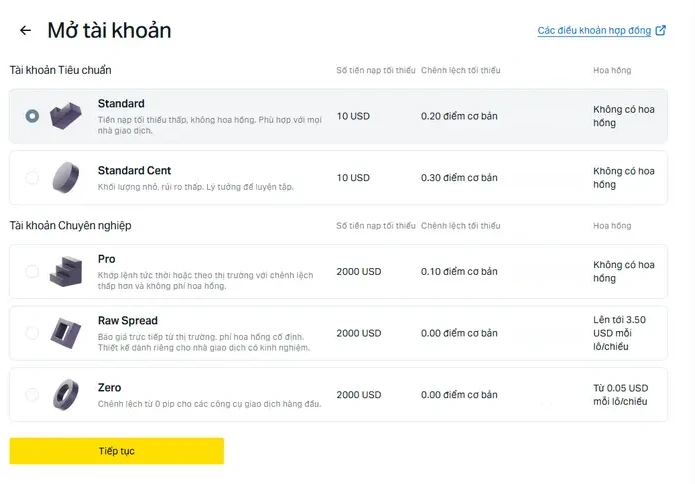
With this structure, the Raw account suits traders who trade a lot and need a low spread, while Standard suits small accounts and traders who place few orders. Both have transparent costs that are easy to work out before opening a trade. More on the Raw account is in Exness Raw Spread account.
IC Markets
IC Markets is known for its Raw Spread model, a popular choice among scalpers and day traders. On the Raw Spread account, the average EUR/USD spread is about 0.1–0.3 pips. Commission is about 7 USD per lot round-turn on MT4/MT5 and about 6 USD on cTrader.
As a result, total costs are low and stable through the European and US sessions, which suits high-frequency trading. The commission is published clearly, so there are no surprise charges.
XM
Unlike the other two, XM targets beginners and low-frequency traders with commission-free accounts. Typical EUR/USD costs are:
- Standard: no commission, average spread of about 1.0–1.6 pips.
- Ultra Low: no commission, average spread of about 0.6–0.8 pips.
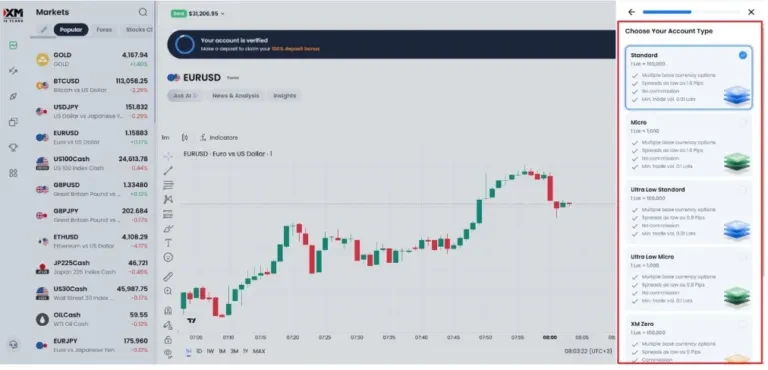
With no commission to add, costs at XM are very easy to calculate, and the stable spread suits beginners. In exchange, this structure is not optimal for high-frequency scalping.
Total cost of one EUR/USD lot
Combining spread and commission, the estimated total cost of one EUR/USD lot on each account is:
| Account | Estimated total cost (USD/lot) |
|---|---|
| Exness Raw | about 7–9 |
| IC Markets Raw | about 6–8 |
| XM Standard | about 10–16 |
| XM Ultra Low | about 6–8 |
These ranges are broad estimates, so they do not match a straight addition exactly. On Exness Raw, for example, a 0.0–0.3 pip spread (0–3 USD) plus 7 USD commission gives 7–10 USD. On IC Markets Raw, the same addition gives 8–10 USD on MT4/MT5 and 7–9 USD on cTrader. Traders should therefore redo the sum using the spreads they actually see.
Matching the account to the trading style
Based on the cost table, each style has its own sensible choice:
| Style | Priorities | Accounts that usually come out ahead |
|---|---|---|
| Scalping, many trades | Low spread, clear commission | IC Markets Raw, Exness Raw |
| Day trading | Balance of spread and commission | Exness Raw, XM Ultra Low |
| Swing trading | Few trades, long holds, easy cost control | XM Standard, Exness Standard |
| Beginners, few trades | Costs that are easy to understand | XM Ultra Low, XM Standard |
| Small accounts | Fees that do not erode the balance | Exness Standard, XM |
In general, the more often a trader opens positions, the stronger the case for a Raw account. Traders who place few orders, on the other hand, benefit more from the simplicity of a commission-free account.
Rebates lower the real cost
The table above shows the cost before any rebate. When a trader opens an account through an IB (an introducing broker that refers clients to a broker), the broker shares part of its fee with the IB, and the IB passes that share back to the trader per lot; this is called a rebate or backcom. The mechanism is explained in detail in what is backcom.
Disclosure. BackcomHub is an IB for the brokers in the table below and earns IB commission from them on accounts registered through BackcomHub. The rebate paid to traders comes out of that same commission.
EUR/USD rebates from the BackcomHub rebate table, in US dollars per lot:
| Broker | Account type | EUR/USD rebate (USD/lot) | Referral code | Data as of |
|---|---|---|---|---|
| Exness | Standard & Cent | 3.20 | oc9jb1aix4 | 20 Nov 2026 |
| Exness | Raw & Zero | 0.87 | oc9jb1aix4 | 20 Nov 2026 |
| IC Markets | Standard | 4.00 (flat rate, all symbols) | 91994 | 18 Oct 2026 |
| IC Markets | Raw Spread | 2.00 (flat rate, all symbols) | 91994 | 18 Oct 2026 |
| XM | Standard & Micro | 8.10 | BACK100 | 10 Nov 2026 |
| XM | Ultra Low | 3.15 | BACK100 | 10 Nov 2026 |
Subtracting the rebate from the total cost in the previous section changes the estimated net cost considerably:
| Account | Before rebate (USD/lot) | After rebate (USD/lot) |
|---|---|---|
| Exness Raw | 7–9 | about 6.1–8.1 |
| Exness Standard (0.8–1.0 pips) | 8–10 | about 4.8–6.8 |
| IC Markets Raw | 6–8 | about 4–6 |
| XM Standard | 10–16 | about 1.9–7.9 |
| XM Ultra Low | 6–8 | about 2.9–4.9 |
What stands out is that commission-free accounts usually receive larger rebates, because their cost already sits inside a wider spread. After the rebate, the gap between Standard and Raw accounts narrows clearly and in some cases even reverses. Real spreads vary from moment to moment and rebate rates can change, however, so traders should recalculate with their own figures, as shown in Standard vs Raw.
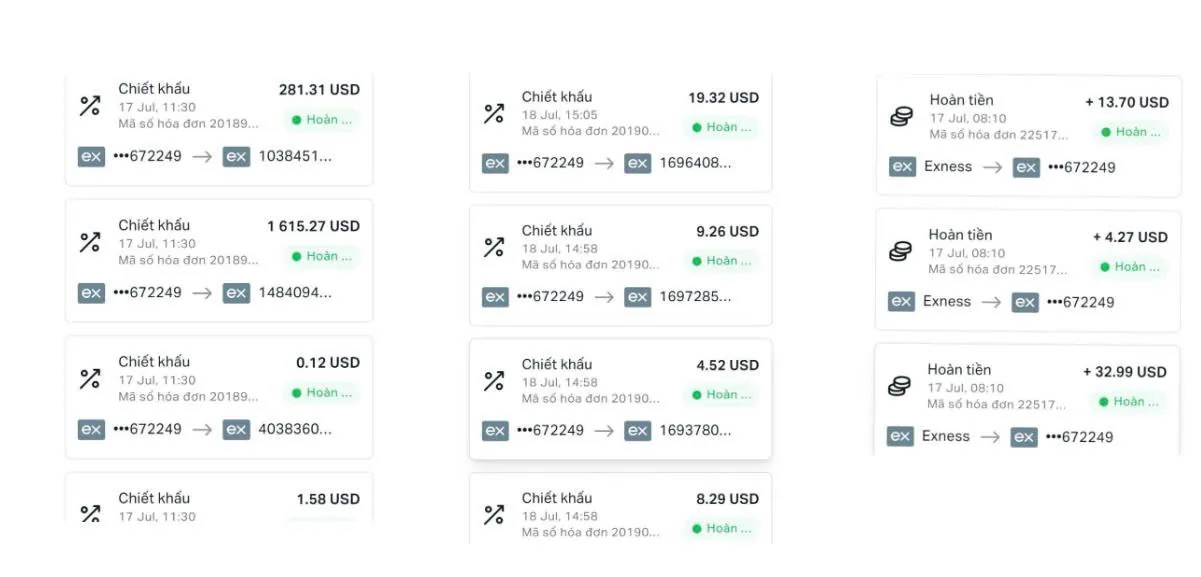
Full rates by symbol are listed in Exness rebate, IC Markets rebate and XM rebate. Traders who already hold an account can read how to switch IB.
FAQ
Does a low-cost broker make winning easier?
No. Low fees only reduce costs, while trading results still depend on strategy and risk management.
Is a low spread with a high commission cheap?
It can be, if spread plus commission is still lower than the alternatives. Traders therefore always need to compare the total of the two.
Which low-cost broker suits beginners?
XM and Exness are usually easy to start with, because their costs are clear and not complicated. Beginners can therefore work out fees before entering a trade.
Should traders pick a broker just for a "0.0 spread" advert?
No. Traders need to look at the average spread and the actual commission that comes with it.
Who is hit hardest by trading fees?
High-frequency traders and small accounts are affected most. The reason is that fees add up with every trade, and a small balance struggles to absorb a steady drain.
Cost summary
There is no single answer to which broker is cheapest, because cost depends on each trader's style and frequency. Traders who place many orders and want the lowest total cost usually do best with the Raw accounts at IC Markets or Exness. Beginners, low-frequency traders and small accounts, meanwhile, find costs easier to control on commission-free accounts such as XM or Exness Standard. Whichever account is chosen, the number to compare is spread plus commission minus the rebate, not an advert for a low spread.
Sources
- Official broker websites, where traders should check current spreads and commissions: https://www.exness.com, https://www.icmarkets.com, https://www.xm.com.
- BackcomHub rebate table, data from dctoptrade.vn: Exness as of 20 Nov 2026, XM as of 10 Nov 2026, IC Markets as of 18 Oct 2026.
- DCtoptrade (screenshots): https://dctoptrade.vn/


