
CFI Financial Review 2026
CFI Financial review 2026: history since 1998, six licences and the entity Vietnamese clients get, two account types, fees, MT5 and cTrader, payments, support.

Many Forex brokers become known in Vietnam through heavy advertising. CFI Financial is a different kind of brand: quiet, but in business for more than two decades. The group is present in most major financial centres and treats its longevity as its main competitive edge. A long history alone does not make a broker a good fit for Vietnamese traders, however, because their real protection depends on the entity that signs the contract, on costs and on how deposits and withdrawals work.
The sections that follow cover CFI's origins, its licences, the product range, platforms, account types and costs, client fund protection, payments and support, then the pros and cons and how well the broker suits Vietnamese traders. Fees, spreads and leverage can change over time, so traders should check the current conditions on CFI's official website before opening an account.
What CFI Financial is
Founded in Lebanon, expanded across continents
The group's full name is Credit Financier Invest Group, usually shortened to CFI Financial Group. It was founded in 1998 in Lebanon, which places it among the oldest brokers in the Middle East. Over more than twenty-five years CFI expanded into the UK, Cyprus, the UAE with a hub in Dubai, Jordan, South Africa, Seychelles and Vanuatu. Today the group's headquarters are in Mauritius.
The broker's stated mission
CFI says it wants to be a gateway to global markets for every kind of investor, with three priorities: transparency, security and the trading experience. Its long-running slogan, "Empowering Traders Since 1998", expresses that commitment to strengthening traders through technology and service. Statements like these only carry weight when backed by clear licences, so the next section looks at the group's regulatory set-up.
Licences and legal entities
Six regulators
CFI does not operate through a single company but through several entities, each licensed by the regulator of its own jurisdiction. The licences listed are:
| Jurisdiction | Regulator | Licence number |
|---|---|---|
| United Kingdom | FCA (Financial Conduct Authority) | 828955 |
| Cyprus | CySEC (Cyprus Securities and Exchange Commission) | 179/12 |
| Dubai, UAE | DFSA and SCA | Not stated |
| South Africa | FSCA (Financial Sector Conduct Authority) | 53711 |
| Seychelles | FSA (Financial Services Authority) | SD107 |
| Vanuatu | VFSC (Vanuatu Financial Services Commission) | 700479 |
The list shows that the CFI brand is recognised as legal in many regions, including two strict ones, the UK and Cyprus. Traders can look up the licence numbers on the FCA or CySEC registers to confirm that the company name matches the one on their contract.
The entity that serves Vietnamese clients
Client protection is not the same across entities, and this is the point Vietnamese traders most need to understand. Accounts for clients from Vietnam are usually opened under the Seychelles or Mauritius entity, both of which supervise far more lightly than the FCA in the UK or CySEC in Cyprus. In other words, a Vietnamese client trades under the CFI brand but does not automatically receive the rights that British or European law gives to clients of those entities. Before opening an account, therefore, traders should read the legal agreement carefully to see which company is named and who supervises it.
Products
More than 15,000 instruments
CFI says its range covers more than 15,000 financial products across all the main asset classes:
- Currencies (Forex): major, minor and exotic pairs such as EUR/USD, GBP/JPY and USD/TRY.
- International shares: large names such as Apple, Amazon, Tesla, Meta and Google.
- Stock indices: Nikkei 225, DAX 30, NASDAQ 100 and S&P 500.
- Precious metals: gold (XAU/USD) and silver (XAG/USD).
- Energy: WTI crude, Brent crude and natural gas.
- Cryptocurrencies: Bitcoin, Ethereum, Ripple and Litecoin.
With that many choices, a single CFI account lets traders follow almost every major market without opening accounts elsewhere.
Real shares alongside CFDs
What sets CFI apart is direct access to major stock exchanges such as NYSE, NASDAQ, the LSE in London and HKEX in Hong Kong. As a result, traders can combine two approaches in one place. The first is short-term trading with CFDs (contracts for difference), which pay out or lose according to price moves without ownership of the asset. The second is buying physical shares as a long-term investment, which helps diversify a portfolio.
Trading platforms
MT4 and MT5
CFI offers both familiar versions of MetaTrader. MT4 has an easy interface, runs automated trading robots (Expert Advisors, or EAs) and therefore suits beginners. MT5, by contrast, is the upgraded version with 21 timeframes, 38 built-in indicators and faster order execution.

cTrader and the CFI app
Besides MetaTrader, traders can use cTrader, a platform aimed at professional traders. cTrader is strong on Depth of Market, the panel that shows how much volume is waiting at each price level, and it has advanced automation tools. CFI also has its own mobile app, the CFI Trading App. The app handles deposits and withdrawals, live prices, order placement, price alerts and market news directly on a phone.
TradingView connection
CFI accounts can also be linked to TradingView, the charting platform favoured by many technical analysts. Once connected, traders place orders straight from the TradingView chart instead of switching between two programs. TradingView is sometimes hard to reach from Vietnam, and the article on TradingView access problems explains how to recognise the issue.
Overall platform experience
According to the broker, its platforms run 24/5 with low execution latency and remain stable on both desktop and mobile. Many professional traders also value being able to switch between MT5, cTrader and TradingView without registering again. Overall, the interfaces are described as smooth, rarely laggy and easy to use on mobile devices.
Accounts and costs
Two account types
CFI currently offers two main accounts, one for traders who want simple pricing and one for those who need tight spreads:
| Account | Commission | Spread | Max leverage (offshore) | Best for |
|---|---|---|---|---|
| Zero Commission | USD 0 per lot | From 0.4 pip | 1:500 | Traders who want easy-to-read costs |
| Dynamic Trader | About USD 6 per lot | Tighter than Zero Commission | 1:500 | Scalpers |
The two accounts differ in how they charge. Zero Commission charges no separate commission, so the whole cost sits in the spread, the gap between the buy and sell price. Dynamic Trader, on the other hand, charges about USD 6 per lot in exchange for a lower spread, which suits traders who open and close many positions a day. The trade-off between the two pricing models is explained in detail in spread vs commission.
Leverage, minimum deposit and other fees
Beyond spread and commission, traders should note a few more conditions:
- Leverage: up to 1:500 at offshore entities, but only 1:30 for EU or UK clients.
- Minimum deposit: USD 0 to 100 depending on the account.
- Inactivity fee: charged once an account has had no trades for three months.
- Withdrawal fee: USD 0 to 25 depending on the method.
Leverage of 1:500 means USD 1 of margin controls a USD 500 position, so both profits and losses are magnified to the same degree. Traders new to the idea can read leverage in Forex before choosing a level.
Costs compared with other brokers
Taken as a whole, CFI's costs are fairly competitive. Once real spreads and international withdrawal fees are included, though, CFI is still slightly more expensive than some large brokers such as Exness or IC Markets. The difference is offset by steady customer service and a wide choice of platforms.
Fund safety and security
Three layers of client protection
CFI says it follows international standards for managing client money, through three mechanisms:
- Segregated client funds: investors' money is held at separate banks and cannot be used for the broker's own operations.
- Negative Balance Protection: a client's loss cannot exceed the amount deposited as margin.
- Regular audits: each entity is audited independently under the rules of its own region.
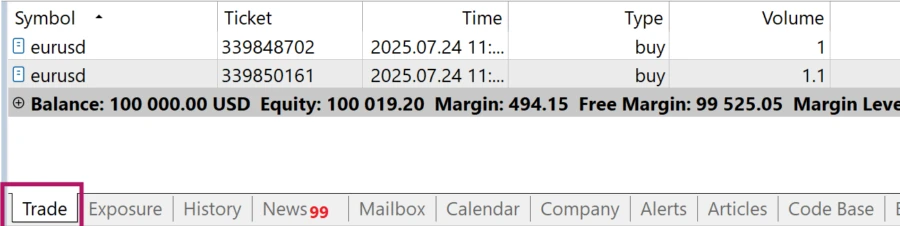
Negative balance protection is easiest to grasp with an example. If a sharp price jump pushes the account's equity below zero, the broker resets the balance to zero instead of asking the client to pay in more money. These protections do not, however, remove the ordinary risk of losing money when trading with leverage.
Data security
On the technical side, CFI uses two-factor authentication (2FA), SSL encryption for all data and an internal risk-monitoring system that runs in real time. These measures reduce the risk of intrusion or cyberattack, a common concern in online trading. Even so, traders should switch on 2FA themselves and never share their password with anyone.
Deposits and withdrawals
Payment channels
CFI lets clients move money in and out of their accounts in several ways:
- Visa and MasterCard.
- International bank wire transfer.
- Skrill and Neteller e-wallets.
- Cryptocurrency, including Bitcoin and USDT.
Processing times and fees
Processing speed depends on the channel. E-wallet deposits arrive almost instantly, while withdrawals by international bank transfer take about 1 to 3 business days. Withdrawal fees range from USD 0 to 25, depending on the entity and the method chosen.
A test withdrawal before a large deposit
A simple check is to withdraw a small amount, around USD 50 to 100, before putting serious capital into the broker. That test shows the real processing time and the actual conversion rate at the entity the trader signed up with. The view of the payment process is then based on real experience rather than on marketing claims.
Customer support
Official contact channels
CFI's support team serves clients worldwide in several languages, including English and basic Vietnamese. Clients can reach it through the following channels:
- General email: global@cfi.trade; UK email: uk@cfi.trade; Dubai email: dubai@cfifinancial.com.
- International phone line in Mauritius: +230 460 8266.
- UK phone: +44 (0)20 3907 4131; Dubai phone: +971 4 770 6717.
- Live chat on the cfi.trade website.
What users say
On Trustpilot, CFI has more than 2,000 reviews with an average score of 4.8 out of 5. Most clients praise the support team for answering quickly and acting professionally. Some complain about slow withdrawals at peak times, although these cases are generally resolved promptly.
Execution performance
CFI places its trading servers in major financial data centres in London and Dubai, so orders are processed quickly and reliably. A published test on MT5 put the average execution time at only about 60 to 90 milliseconds. That speed is enough for scalpers and EA users, whose strategies are highly sensitive to latency.
Pros and cons
Pros
CFI's main strengths are:
- A range of more than 15,000 products covering most major markets.
- Both TradingView and cTrader, a combination few brokers offer.
- MT5 tuned for speed and stable EA performance.
- Licences from the FCA, CySEC, DFSA, FSCA, FSA and VFSC.
- A 24/5 support team that responds quickly and professionally.
- Basic Vietnamese-language support.
Cons
On the other side, traders should weigh a few weaknesses:
- Protection varies with where the account is opened. Vietnamese clients usually fall under an offshore entity, so they lack the investor compensation available to clients of the FCA or CySEC entities.
- International withdrawal fees can reach USD 25.
- Real spreads are sometimes higher than advertised.
- Scalping is occasionally restricted, depending on market conditions.
Weighing the two lists, CFI's strengths lie in its products and platforms, while its weaknesses are mostly about the legal entity and withdrawal costs.
Is CFI a good fit for Vietnamese traders
Advantages for Vietnamese clients
For Vietnamese clients, CFI has three main advantages. First, support is available in basic Vietnamese. Second, deposits and withdrawals through international e-wallets are convenient. Third, the platforms are easy to use, so beginners can get comfortable quickly.
What to check before opening an account
Before depositing a large sum, Vietnamese traders should confirm which entity they belong to and what fund protection that entity offers. Those who put safety first should choose an entity licensed by CySEC or the FCA where the broker allows that choice. It also helps to check any broker against the points in six warning signs of a Forex scam broker.
FAQ
Is CFI Financial legal?
Yes. The group holds licences from several major financial regulators, including the FCA, CySEC, DFSA, FSCA, FSA and VFSC. Each licence, however, covers only the clients of the specific entity that holds it.
Which entity do Vietnamese clients belong to?
Accounts for Vietnamese clients are usually opened with the Seychelles or Mauritius entity. Both jurisdictions supervise more lightly than European regulators.
Does CFI accept crypto deposits and withdrawals?
Yes. The broker accepts Bitcoin and USDT, which makes transfers fast and convenient.
Are CFI's spreads and fees competitive?
CFI's spreads sit in the mid-to-good range, starting at 0.4 pip, and commissions are low. That pricing works for both beginners and professional traders.
Is CFI suitable for trading international shares?
Very much so, because the broker offers direct access to major exchanges such as NYSE, NASDAQ and the LSE. Traders can therefore trade share CFDs short term and also buy real shares to hold long term.
Does CFI offer Vietnamese-language support?
Yes, though not fully. The support teams in Dubai and Mauritius can assist Vietnamese clients in English and basic Vietnamese.
Conclusion
CFI Financial Group is a long-established international broker with a broad set of licences and strong technology. Its main drawbacks are the offshore entity used for Vietnamese clients and a few fees, especially for international withdrawals. For investors who want stability, a diverse product range and a long-term trading home, CFI is still worth considering, provided they check the entity and make a test withdrawal before depositing serious capital.
Sources
- CFI Financial official website: https://cfi.trade/
- FCA Financial Services Register: https://register.fca.org.uk/
- CySEC list of regulated entities: https://www.cysec.gov.cy/
- CFI reviews on Trustpilot: https://www.trustpilot.com/
- DCtoptrade (screenshots): https://dctoptrade.vn/


