
Exness Review 2026
Exness review 2026: entities and licences, the legal question in Vietnam, five account types, fees, client-fund safety, pros and cons and rebates per lot.
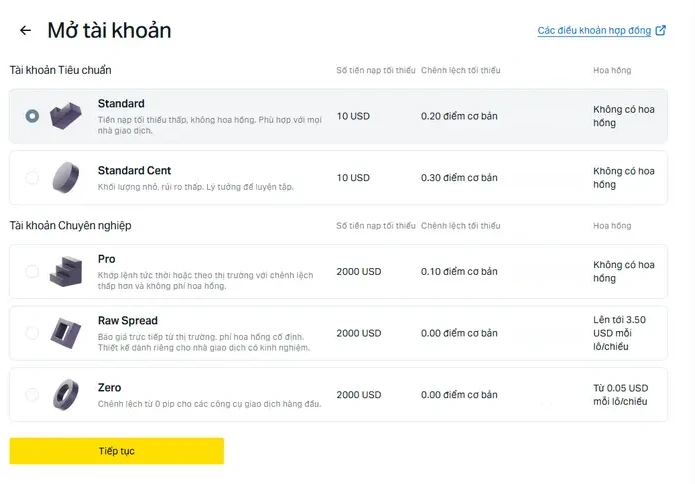
Exness is among the forex brokers with the largest trading volume in the world, and the name is very familiar to Vietnamese traders. However, size does not mean the absence of risk. Many broker reviews skip a question that matters a great deal to Vietnamese clients, namely where trading through Exness stands under domestic law, even though that is the first thing to understand.
The sections that follow cover what Exness is, its standing entity by entity, its legality in Vietnam, products and account types, fees, how the broker holds client money and secures accounts, and then pros and cons, practical precautions and frequently asked questions. The content draws on the broker's public licences and mainstream Vietnamese media, and is for reference only, not investment or legal advice. Forex and CFD trading carries high risk, and conditions such as fees, spreads and leverage can change, so traders should check them on Exness's official website before opening an account.
What Exness is
Exness is a forex and CFD broker founded in 2008. A CFD, or contract for difference, is a contract in which the buyer never owns the underlying asset and simply gains or loses with its price movement. Thanks to that structure, Exness clients can trade currencies, metals such as gold and silver, indices, shares and cryptocurrencies from a single account.
Organisationally, Exness is not one company but a group of subsidiaries, known as entities. Each entity is licensed in a different place, and which one a client is assigned to depends on their country of residence. This point determines the real level of protection, so the next section examines it in detail.
According to figures published by the broker itself, Exness handles monthly trading volume in the trillions of US dollars, placing it among the most liquid retail brokers worldwide. Beyond scale, traders often mention two features. The first is fast withdrawals, which with some methods usually take only a few minutes. The second is unlimited leverage at some entities based in lightly regulated (offshore) jurisdictions.
Standing by entity
Internationally, Exness is considered fairly reputable, because many financial regulators have licensed its entities. Even so, the protection a trader actually receives depends on the entity named on that trader's own contract, not on the best licence in the group.
The regulators licensing Exness entities include the UK Financial Conduct Authority (FCA), the Cyprus Securities and Exchange Commission (CySEC) in the European Union, South Africa's Financial Sector Conduct Authority (FSCA) and the Seychelles Financial Services Authority (FSA). Accounts held with an entity supervised by the FCA or CySEC are generally better protected, thanks to investor compensation funds and leverage caps under UK and EU rules. By contrast, the Seychelles entity places almost no limit on leverage, but it also carries far fewer client-protection obligations.
Historically, Exness has never collapsed or failed to pay clients, unlike some forex and CFD brokers that have had to close. However, most Vietnamese clients in practice trade through offshore entities in Seychelles or the British Virgin Islands (BVI), because account opening there is easier. Vietnamese traders should therefore understand that their legal protection is considerably weaker than that of clients of the FCA or CySEC entities.
Legality in Vietnam
This is the most important question, and the answer needs to be stated plainly. At present, the provision of forex trading services in Vietnam by international brokers such as Exness is not licensed under Vietnamese law. Investors therefore need to understand the legal risk before taking part.
In a report published by VnExpress in May 2025, the State Bank of Vietnam stated that it had not licensed any foreign-exchange trading platform to operate in the country. Earlier, when reporting on Exness's very large trading volume in Vietnam during 2022–2023, the newspaper Lao Dong described it outright as an illegal forex broker in Vietnam. In addition, police in some provinces have issued notices warning the public about the risks of trading through unlicensed platforms.
A legal grey area
According to an analysis by the legal portal Thu Vien Phap Luat, no current legal document prohibits individuals from trading forex, but the law also does not allow any organisation to run a licensed forex brokerage in the country. In other words, an individual trading through an offshore broker is not clearly committing a criminal offence. Meanwhile, brokers running business, advertising and recruiting introducing brokers (IBs) in Vietnam without a domestic licence is an issue the press and the authorities have raised many times.
From this, Vietnamese traders using Exness should keep three points in mind:
- Money and trades in the account are not protected by Vietnamese law in the way a domestically licensed financial product would be.
- If a dispute arises, resolving it through the Vietnamese legal system will be very difficult.
- Regulations can change over time, so investors need to follow information from the regulators themselves.
These three points are reference information, not legal advice. Related issues such as tax obligations on forex income are covered separately in forex tax in Vietnam.
Tradable products
Exness offers a fairly broad product range, enough for many different trading styles. The main groups are:
- Forex: more than 90 currency pairs, including majors, minors and exotics from smaller economies.
- Metals: gold (XAUUSD) and silver; gold is popular with Vietnamese traders because its volatility suits short-term trading.
- Indices and share CFDs: major indices such as US30 and NAS100 alongside CFDs on international shares.
- Cryptocurrency CFDs: trading on crypto prices without owning the actual coins.
With all four groups available, a trader can follow currencies, gold, indices and crypto on a single MT4 or MT5 platform. How to download the software and choose the correct server is explained in MT5 Exness download and server login.
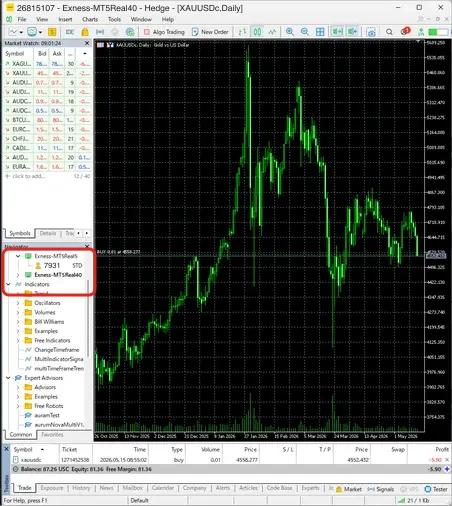
Five account types
Exness has five main account types, which differ mainly in how they charge and how much capital they require:
- Standard: no commission, spreads from 0.3 pips.
- Standard Cent: suits small balances, because balance and volume are counted in cents.
- Pro: tighter spreads than Standard and no commission, but a higher capital requirement.
- Zero: spreads close to zero, with a separate commission.
- Raw Spread: raw spreads close to interbank prices, also with a commission.
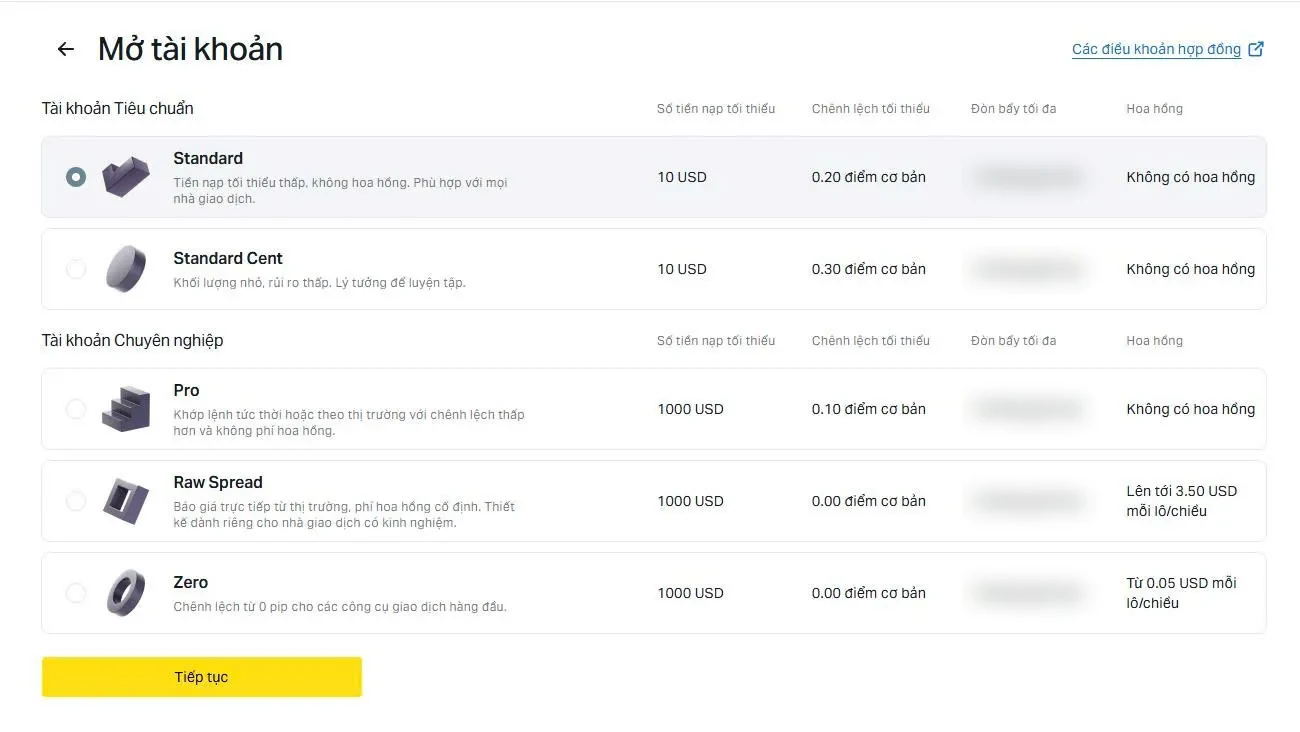
For new traders, Standard or Standard Cent is a sensible starting point, because the cost sits in a single number, the spread. Once comfortable, traders can move to accounts with more complex fee structures such as Zero or Raw Spread, and should read the Exness Zero account review before choosing. In addition, before increasing volume, traders need to understand how leverage affects profit and loss, as explained in forex leverage for beginners.
Trading fees
The cost of each account type is summarised in the table below. The spread is the gap between the buy and sell price, while commission is a separate charge per lot:
| Account type | Spread from | Commission | Suits |
|---|---|---|---|
| Standard | 0.3 pips | None | Beginners |
| Standard Cent | 0.3 pips | None | Small balances, practice |
| Pro | 0.1 pips | None | Experienced traders with more capital |
| Zero / Raw Spread | Near 0 pips | Yes, per lot | High-frequency trading, EAs |
The figures in the table are the commonly published levels at the time of compilation. Exness may adjust them over time and by entity, so traders should check the latest official fee schedule on the broker's website before trading. How to compare spread-only accounts with commission accounts is explained in Standard vs Raw Spread accounts.
A cost example with gold
To see how the spread affects cost, suppose a trader trades 10 lots of gold a month on a Standard account with an average spread of 20 points. That trader's spread cost could reach a few hundred US dollars a month. This is only an illustrative figure to show the scale of the impact, not a fixed fee that applies to every account.
Part of that cost can be recovered through a rebate (backcom), meaning the amount an IB pays back to the trader from the commission the broker pays the IB. According to the BackcomHub rebate table dated 20/11/2026, each lot of XAU/USD on an Exness Standard or Cent account earns a rebate of USD 9.6, Pro earns USD 4.2 and Raw Spread or Zero earns USD 3. The 10 lots of gold on Standard in the example above would therefore return about USD 96 a month. For EUR/USD, the rebate on the same date is USD 3.2 per lot for Standard and Cent, USD 1.49 for Pro and USD 0.87 for Raw Spread or Zero.
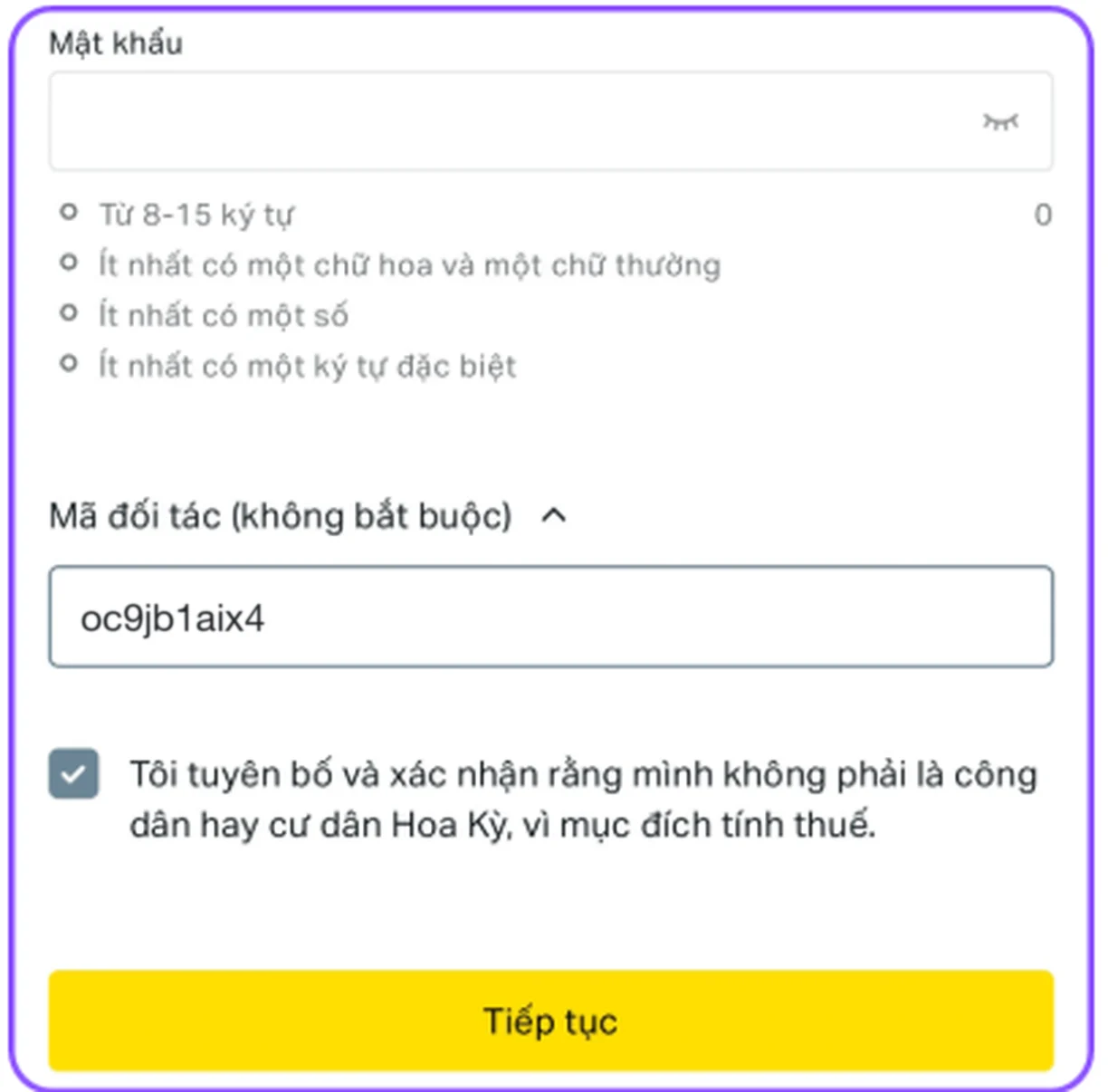
To receive this rebate, traders open an account through the Exness sign-up link on the BackcomHub home page, or enter the partner code oc9jb1aix4 in the partner code field when registering directly on the broker's website. BackcomHub is an IB of the brokers listed on the site and receives IB commission from them; the rebates paid to traders come out of that commission and are credited daily. The mechanism is explained in Exness backcom, and the rates by symbol are on the Exness rebates page. For funding, Exness supports bank transfers and domestic ATM cards, the most common channels for Vietnamese traders.
Client money and account security
At the entities supervised by the FCA and CySEC, Exness holds client money in segregated accounts. This means client funds are kept separately and are not mixed with the company's operating capital. It is a mandatory requirement of both regulators, and it reduces the risk of client money being lost if the broker runs into financial difficulty.
For each individual account, Exness offers two-factor authentication (2FA), login history and alerts when unusual activity is detected. Traders should enable all of these layers and avoid reusing passwords from other services. They should also watch out for fake Exness websites designed to steal login details (phishing), a fairly common trick in Vietnam because the broker has so many users.
Pros and cons
Exness's strengths can be grouped into five points:
- High liquidity and trading volume, with fast withdrawals through many methods.
- Many account types, serving everyone from small-balance traders to professionals.
- Entities supervised by the FCA and CySEC, with segregation of client money.
- No high opening balance required; some accounts start from USD 10.
- Vietnamese-language support and funding channels familiar to local users.
On the other side, traders should weigh four weaknesses:
- The broker's forex services in Vietnam are not licensed by the State Bank, which brings legal risk.
- Most Vietnamese clients belong to offshore entities in Seychelles or the BVI, and are less protected than clients of the FCA or CySEC entities.
- High leverage at offshore entities can easily amplify losses when money management is poor.
- In 2023 the broker was named by the Vietnamese press in connection with unlicensed activity in Vietnam.
The two lists show that Exness's strengths lie in its infrastructure and products, while its weaknesses come mainly from legal status and entity structure. The precautions in the next section therefore focus on exactly those weaknesses.
Precautions before trading
Before depositing with Exness, traders should do the following five things:
- Identify the entity holding their account, FCA, CySEC or offshore, to know the actual level of protection.
- Weigh the legal risk in Vietnam carefully, especially when planning to trade with large capital.
- Only use money they can afford to lose, and avoid high leverage when starting out.
- Enable 2FA and watch out for fake Exness websites and apps spread through social networks and messaging apps.
- Follow changes in Vietnam's forex rules, because the legal framework can change.
When an account problem arises, traders should contact the broker's support team directly through official channels, as listed in the fastest ways to contact Exness support. This is faster and avoids accounts impersonating Exness staff.
Frequently asked questions
Is Exness a scam
Exness is not a scam designed to take client money. The broker has operated continuously since 2008, has entities supervised by the FCA and CySEC, and segregates client funds. However, the lack of a State Bank licence in Vietnam is a separate risk that should be assessed on its own, not merged with the question of whether the broker is a scam.
Is Exness banned in Vietnam
At the time of compilation, there was no official nationwide order blocking access to Exness. Even so, the forex services of international brokers such as Exness in Vietnam remain unlicensed by the State Bank. Some media outlets have reported temporary access blocks on the broker, so traders should check the latest information themselves before trading.
Which entity is safer
Entities supervised by the FCA in the UK or CySEC in Cyprus generally protect investors better than offshore entities in Seychelles or the BVI. The reason is that both regulators require segregation of client money and cap leverage. Before depositing, traders should therefore read the entity name on the account-opening agreement carefully.
Is trading through Exness in Vietnam illegal
Vietnamese law currently has no specific rule prohibiting individuals from trading forex through international brokers. At the same time, the state does not license any forex broker to operate officially in the country. This is an unclear legal area, so each investor needs to assess the risk independently, and the content here is not legal advice.
Overall assessment
Exness is a large forex broker with stable trading infrastructure, and some of its entities are supervised by reputable regulators such as the FCA and CySEC. On the other hand, the legality of international forex activity in Vietnam remains a grey area that the Vietnamese press and authorities have raised many times. Investors should therefore study both the legal and financial risks carefully, and only trade with capital they can afford to lose.
For traders who understand the broker and want to cut costs, rebates are a way to recover part of the spread and commission already paid. Those who trade a lot of gold can see the detailed calculation in Exness gold rebate per lot. Even so, rebates lower costs rather than risk, so traders should not increase volume just to collect more rebates.
Sources
- Exness, official website, https://www.exness.com/ — publishes entities, licences, account types and fees; traders should check here because conditions can change.
- UK Financial Conduct Authority (FCA), Financial Services Register, https://register.fca.org.uk/
- Cyprus Securities and Exchange Commission (CySEC), https://www.cysec.gov.cy/
- Financial Sector Conduct Authority (FSCA), South Africa, https://www.fsca.co.za/
- Seychelles Financial Services Authority (FSA), https://fsaseychelles.sc/
- VnExpress, State Bank of Vietnam statement on foreign-exchange platforms (May 2025), https://vnexpress.net/
- Lao Dong newspaper, reporting on Exness in Vietnam (2022–2023), https://laodong.vn/
- Thu Vien Phap Luat, analysis of forex trading in Vietnam, https://thuvienphapluat.vn/
- BackcomHub rebate table, data from dctoptrade.vn, updated 20/11/2026.
- Images: DCtoptrade (screenshots): https://dctoptrade.vn/


