
Funded Next Prop Firm Review
Funded Next is a prop firm funding forex traders. How its Evaluation and Express models work, drawdown limits, profit splits, reset fees, pros, cons and FAQs.

For many Vietnamese traders, Funded Next is still an unfamiliar name, even though the firm has paid out profits to thousands of traders in many countries. It belongs to the proprietary trading firm (prop firm) category: a trader pays a fee to sit a trading test, and on passing gets to trade the firm's capital and share the profit with it. The first thing worth understanding, then, is the rulebook of that test rather than the promise of a large account.
The sections that follow cover who Funded Next is, how its two challenge account types work, what resets cost, whether the firm can be trusted and the questions newcomers tend to ask. The rules, fees and ratings were recorded in 2023, so traders should check them again on the official Funded Next website before signing up, because prop firms change their conditions fairly often.
What Funded Next is
Funded Next is a funding firm for foreign exchange traders that officially opened in March 2022 after a little over two years of testing. The business behind it is NEXT Ventures, a group of digital companies serving more than 20,000 customers in over 100 countries. Besides Funded Next, the group owns products such as FINALYTICS, ECOMCHEF and MONEYBACK FX. The firm is headquartered at AI Robotics HUB, C1 Building, in the United Arab Emirates (UAE).
Funded Next's pitch rests on three points. First, it advertises funding of up to 4 million USD per trader. Second, traders may use almost any trading strategy. Third, the trader's share of profit can reach 90%. These figures are ceilings, however, and reaching them means getting past the limits described in the sections below.
Two challenge account types
Funded Next sells two products, the Evaluation account and the Express account. Both lead to becoming a funded trader, but they differ in the number of phases, the profit target and the way profit is split. Two terms appear throughout the rules and are worth understanding first.
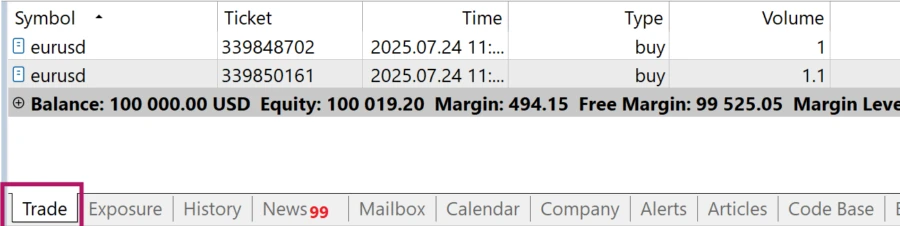
The first is the maximum daily drawdown, meaning the largest loss allowed within a single trading day, expressed as a percentage of the account. The second is the maximum overall drawdown, meaning the largest total loss the account may take from the start. Hitting either threshold counts as failing the challenge. Traders used to reading Balance and Equity in MT4 or MT5 will therefore find these limits easier to track.
Evaluation: a two-phase test
The Evaluation model has two stages: an assessment stage in which the trader proves their skill, then a funded stage once they pass. The assessment stage itself has two phases with slightly different rules. Phase 1 sets these conditions:
- a daily loss of no more than 5%;
- a total account loss of no more than 10%;
- at least 5 trading days;
- a profit target of 10%.
Once those targets are met over at least 5 trading days, the trader moves on to phase 2. Phase 1 also has two softer clauses. If the cycle ends before the 10% target is reached but no rule has been broken and the closed positions are in profit overall, the firm provides a new challenge account free of charge; this applies to phase 1 only. In addition, a trader who feels short of time can ask for phase 1 to be extended by 14 days, provided they have traded for at least 5 days and already made 5%.
Phase 2 keeps both loss limits and only lowers the profit target. Specifically, the trader still may not lose more than 5% in a day or let the account fall more than 10%, still needs at least 5 trading days, and the profit target drops to 5%. Unlike phase 1, there is no second chance here: failing phase 2 means paying for a brand-new challenge account.
After both phases, the trader enters the funded stage and receives a live account. Keeping it requires sticking to the same two limits, a 5% maximum daily loss and a 10% maximum overall loss. Once the account is in profit, the trader may request a first withdrawal. On that first payout the trader receives 80% of the funded account's profit, plus 15% of the profit made during the two challenge phases, and also gets back the fee paid for the challenge account.
Express: one phase, no time limit
The Express model shortens the path, since the trader only has to pass a single challenge phase. The goal of that phase is a total profit of 25%, and the firm sets no deadline for reaching it. The two loss limits are the same as for Evaluation: a 5% maximum daily loss and a 10% maximum overall loss.
Profit sharing also works differently on Express. From the very start, the trader is entitled to 15% of the profit made on the account. Once cumulative profit reaches 25%, the trader is given a new account, and the split rises with each withdrawal as follows:
- after the first withdrawal: 60%;
- after the second withdrawal: 75%;
- from the next withdrawal onwards: 90%.
The advertised 90% therefore only arrives after several successful payout cycles. Express also requires at least 10 trades and at least 10 trading days every month.
Express with and without the consistency rule
When buying an Express account, the trader chooses one of two variants: with the consistency rule (Consistency) or without it (Non-Consistency). The Consistency variant is stricter, because the firm requires stable trading habits from week to week. The three metrics tracked are the number of trading days, the number of trades and the volume in lots.
The firm applies this rule quite mechanically. At the end of each week it takes the average of the metrics for that week, then sets an upper bound at the average multiplied by 2 and a lower bound at the average divided by 2. In the following week, the trader must keep their own averages between those two bounds.
An example makes the calculation clear. Suppose that in week 1 a trader traded on 4 days, opened 70 trades and traded 56 lots in total. The average number of trades per day is then 70 divided by 4, or 17.5, and the average volume is 56 divided by 4, or 14 lots. In week 2, the average number of trades must stay between 8.75 (17.5 divided by 2) and 35 (17.5 multiplied by 2), and the average volume between 7 lots (14 divided by 2) and 28 lots (14 multiplied by 2).
A trader who steps outside these ranges does not lose the live account outright. Instead, the firm suspends the account and resets the balance to its starting level. That means existing profit can be lost, so anyone choosing Consistency needs an even trading rhythm rather than a very busy week followed by a near-idle one.
Challenge reset fees
A reset means paying a fee to return a challenge account to its starting state and try again, instead of buying a new account at full price. Funded Next presents its discounted reset policy as an advantage over many other firms. Even so, resets apply only to challenge accounts, not to live funded accounts.
The reset fee depends on account size and account type, as the following table shows:
| Account size | Evaluation | Express with Consistency | Express without Consistency |
|---|---|---|---|
| 15,000 USD | 89 USD | 79 USD | 95 USD |
| 25,000 USD | 179 USD | 159 USD | 183 USD |
| 50,000 USD | 269 USD | 239 USD | 303 USD |
| 100,000 USD | 494 USD | 439 USD | 559 USD |
| 200,000 USD | 899 USD | 799 USD | Not in the price list |
The table shows that Express with Consistency is the cheapest at every size, while Express without Consistency is the most expensive. The 200,000 USD size for Express without Consistency does not appear in the recorded price list, so traders interested in it should ask the firm.
Is Funded Next trustworthy
On reputation, data recorded in 2023 shows Funded Next rated 4.7 on Trustpilot, with 2,235 of 2,580 reviews at five stars. The broker the firm used to execute trades at the time was Eightcap. The firm also sits under NEXT Ventures, a large digital business with offices in several countries, which is why it is usually placed among the trustworthy names.
A Trustpilot score and a large parent company are only signals, however. A prop firm is not a licensed broker holding the trader's margin, so what traders really need to check is whether the firm pays out according to the rules it publishes. General red flags are covered in six warning signs of a forex scam broker.
Pros and cons
Weighing both sides, Funded Next has four clear strengths:
- moderately priced challenge accounts;
- discounted resets for challenge accounts;
- a high profit split of up to 90%;
- a support team that answers feedback quickly and helpfully.
On the other hand, the firm has two weaknesses worth considering for traders in Vietnam:
- an unstable connection from Vietnam to the trading server;
- fairly high spreads that move around a lot.
These two drawbacks weigh more than they first appear to. The spread, meaning the gap between the buy and sell price, is a cost paid on every trade, so a high spread makes the profit target harder to reach while the loss limits stay the same. How that cost adds up is explained in spread vs commission.
What the trader community says
On popular forums and social networks, most feedback about Funded Next is positive. One trader said they were paid within their first month and then received another payout afterwards, describing the service as excellent. Another described the firm as professional and legitimate, adding that their account manager helped sort out every problem that came up. A third praised on-time payments and good support, and said they would recommend the firm to others.
These comments are individual experiences, though. Traders who fail a challenge tend to speak up less than those who get paid, so it is worth reading the negative reviews as well before deciding.
Frequently asked questions
Does Funded Next restrict any countries?
Yes. The firm does not serve certain countries where prop firm services are not offered or not permitted. The list of those countries is not given in the terms of service, however, so traders need to ask support directly.
Who pays tax on the profit?
Traders handle their own tax obligations on the profit they receive. The firm does not withhold or pay tax on their behalf. The tax context for forex income in Vietnam is covered in forex tax in Vietnam.
Which platform is used, and does it work on a phone?
The platform Funded Next provides is MT4. Besides a computer, traders can also trade on a mobile phone.
How can the fee be paid?
The firm accepts many methods. They include cards, bank transfer, BTC, ETH, LTC, DOGE, SOL, USDC (ERC20), Perfect Money, and USDT on both the TRC20 and ERC20 networks.
What is the refund policy?
A refund is available if no trade has been placed on the purchased account within 7 days. In other words, opening a single trade ends the right to a refund.
Are there any other hidden fees?
No, the firm charges no fees beyond those it publishes. Trading costs such as the spread still apply to every trade, as on any account.
Is Funded Next worth trying
Funded Next is fairly young but already has a large following of traders worldwide, thanks to moderate fees, cheap resets and high profit splits. In return, the drawdown limits of 5% per day and 10% overall demand very strict money management, especially when spreads are unstable. Newcomers should therefore understand forex leverage and practise on a demo account before paying a challenge fee.
BackcomHub has no partnership or rebate programme with Funded Next, so the information above is for reference only. Traders interested in cutting costs when trading their own money can read what is backcom.
Sources
- Funded Next, official website: https://fundednext.com/
- Trustpilot, Funded Next review page: https://www.trustpilot.com/review/fundednext.com
- DCtoptrade (screenshots): https://dctoptrade.vn/


