
FP Markets Review 2026
FP Markets review 2026: ASIC, CySEC and FSCA licences, Standard and Raw accounts, fees, MT4, MT5 and IRESS, funding, and what Vietnamese traders should note.
Hundreds of new brokers appear online every year, and most of them attract clients with deposit bonuses and promises of profit. FP Markets goes the other way. It advertises quietly, makes no far-fetched return claims, and keeps clients with three things traders actually care about: low costs, good trading tools and oversight by well-known regulators.
The sections that follow look at what FP Markets is, its licences and client fund protection, the product range, account types, platforms, fees, deposits and withdrawals, strengths and weaknesses, and whether the broker is a scam. Fees, spreads, leverage and account conditions can change, so traders should check them again on the official FP Markets website before opening an account.
What FP Markets is
FP Markets is short for First Prudential Markets, a brokerage founded in 2005 in Sydney, Australia. Australia has strict financial standards overseen by the Australian Securities and Investments Commission (ASIC), so starting there already gave the firm a solid base. Over almost twenty years the broker has expanded into many international markets and now serves hundreds of thousands of traders from more than 80 countries.
Rather than pouring money into promotion, FP Markets puts its effort into service and into how trading feels day to day. It offers more than 10,000 CFD products. A CFD, or contract for difference, lets a trader profit or lose from price moves without owning the underlying asset. The range runs from currencies, shares, indices, crypto and commodities to futures. Alongside it come clear conditions, low spreads and five platforms: MT4, MT5, cTrader, IRESS and TradingView.
FP Markets positions itself as a broker with "plenty of tools but no clutter". In practice, professional traders get enough to fine-tune their strategies, while beginners can still settle in thanks to an easy interface and attentive support. Spreads from 0.0 pips, leverage of up to 1:500 and support for automated trading make it a credible alternative for anyone tired of fake bonuses and hidden fees.
Licences and safety
For a broker, a clear licence and serious supervision usually matter more than any advertising, because they are the only protection when a dispute arises. FP Markets is supervised in several jurisdictions at once, something few mid-sized brokers achieve. Its current licences are:
- ASIC in Australia, regarded as one of the strictest standard-setters in the world.
- CySEC in Cyprus, which allows the broker to serve European Union clients under the MiFID framework.
- FSCA in South Africa, responsible for financial markets in the African region.
- FSA of Saint Vincent and the Grenadines, with far weaker supervision, used mainly for international clients.
This list shows good regulatory coverage, but each licence only protects clients who contract with the specific subsidiary holding it. Traders should therefore read the client agreement to see which entity their account belongs to, rather than assuming ASIC protection.
Beyond licensing, the broker adds three layers of client protection:
- Segregated accounts: client money sits in separate accounts at major banks, apart from the broker's operating capital, which shields it from risks inside the company.
- Negative balance protection: when prices move too violently, the account cannot fall below zero and the trader does not have to pay in more money to cover the deficit.
- SSL encryption and secure payment gateways: these reduce the risk of data leaks or fraud during deposits and withdrawals.
Thanks to these layers, FP Markets is usually ranked among the most trustworthy of the low-cost, well-equipped brokers. Traders still need to be careful, but at least they need not fear the broker vanishing overnight, as can happen with firms of unknown origin.
Tradable products
The FP Markets range suits traders who want many markets in one account, from gold, Bitcoin and the US dollar to crude oil. With more than 10,000 instruments, it supports both basic and advanced strategies. The main product groups are:
- Forex: more than 70 pairs, from majors and minors to exotics such as USD/TRY, GBP/JPY or EUR/USD. On the Raw account spreads start at 0.0 pips, which saves professional traders a lot.
- Share CFDs: about 9,000 stocks listed in India, Singapore, Australia, the UK, the US and other major markets. Besides familiar names such as Tesla, Apple and Alibaba, traders can hunt for opportunities in smaller stocks.
- Indices: 12 or more global indices, including AUS200, Nikkei 225, FTSE 100, NASDAQ and S&P 500, suited to traders who follow the macroeconomic picture.
- Commodities: natural gas, Brent and WTI crude, often used for short-term seasonal plays or trades around geopolitical events.
- Metals: silver and gold, quoted in both USD and AUD, which can be used as a hedge when prices swing hard.
- Crypto: five familiar coins, namely Litecoin, Bitcoin Cash, Ripple's XRP, ETH and BTC, open around the clock.
- ETFs, bonds and options: few mid-sized CFD brokers offer all three groups, so they give traders a way to spread their portfolio and limit risk.
- Futures: access to dated markets in interest rates, indices or commodities, suited to structured hedging strategies.
FP Markets is clearly not just a forex broker but a true multi-asset one. The range serves both the casual trader drawing a trendline now and then and the derivatives trader watching several screens at once.
Account types
FP Markets has a varied but easy-to-choose account line-up, so both beginners and seasoned traders can find a fit. The choice depends on needs and trading style:
- Standard: suits beginners and intermediate traders. It charges no commission and spreads start at around 1.0 pip, so the cost is a single number with no extra fee to add per trade.
- Raw: the professionals' favourite. Spreads from 0.0 pips and a commission of 3 USD per side, or 6 USD per lot opened and closed, among the most competitive in the market. It suits scalpers, high-frequency traders and those running trading robots (EAs).
- Islamic: an account for Muslim traders with no swap (the overnight holding fee), in line with Shariah rules.
- Demo: no time limit as long as the trader logs in at least once every 30 days; otherwise the account is closed. It is meant for practice or testing strategies.
- MAM/PAMM: pooled managed accounts for those who want to delegate, where one manager trades on behalf of many clients at once.
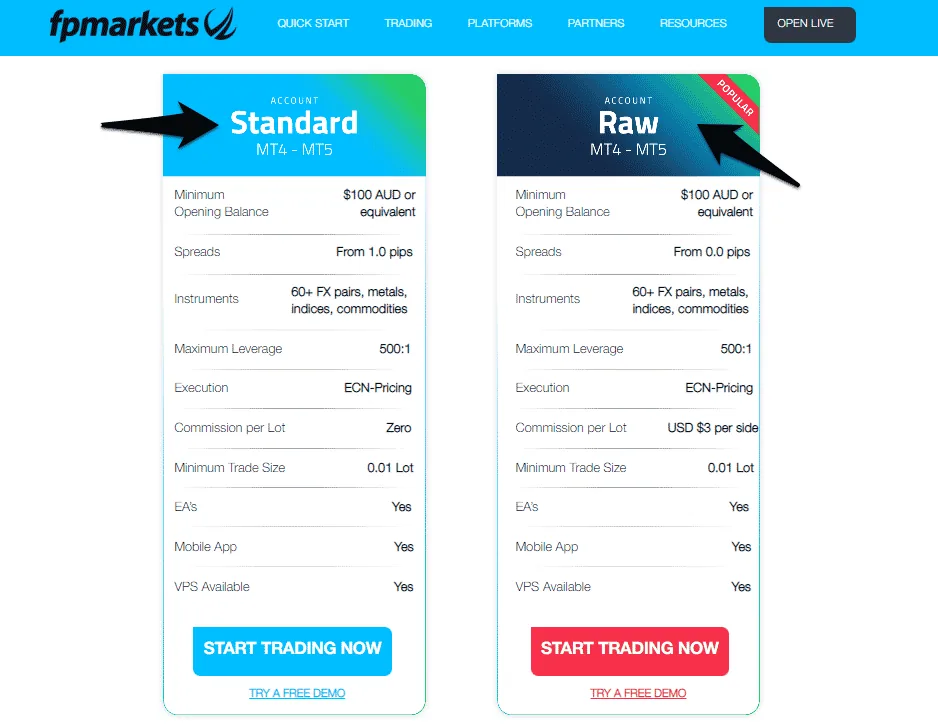
A simple calculation shows the difference between the two main accounts. On EUR/USD, one pip on one lot is worth about 10 USD, so a 1.0 pip spread on Standard costs roughly 10 USD per lot. On Raw, if the spread is close to zero, the cost is mostly the 6 USD commission. Anyone trading many lots a month will see that gap add up, as explained in the guide to Standard vs Raw Spread accounts.
In addition, every account falls under the fund segregation described in the licence section, so client capital is held apart from the broker's operating money. FP Markets does not, however, accept clients from the United States, like many international brokers because of US law. In other countries, Vietnam included, opening an account is fairly easy and transparent.
Trading platforms
Besides its products, FP Markets stands out for a software line-up that serves every level. Whether on a laptop, a phone or a multi-screen desktop setup, clients have a suitable tool. Apart from cTrader, mentioned earlier, the main platforms are:
- MT4 and MT5: the classic pair most traders already know. Both are highly customisable, run EAs and indicators, show charts across many timeframes and execute quickly. MT5 goes beyond MT4 in portfolio tracking and in-depth reports.
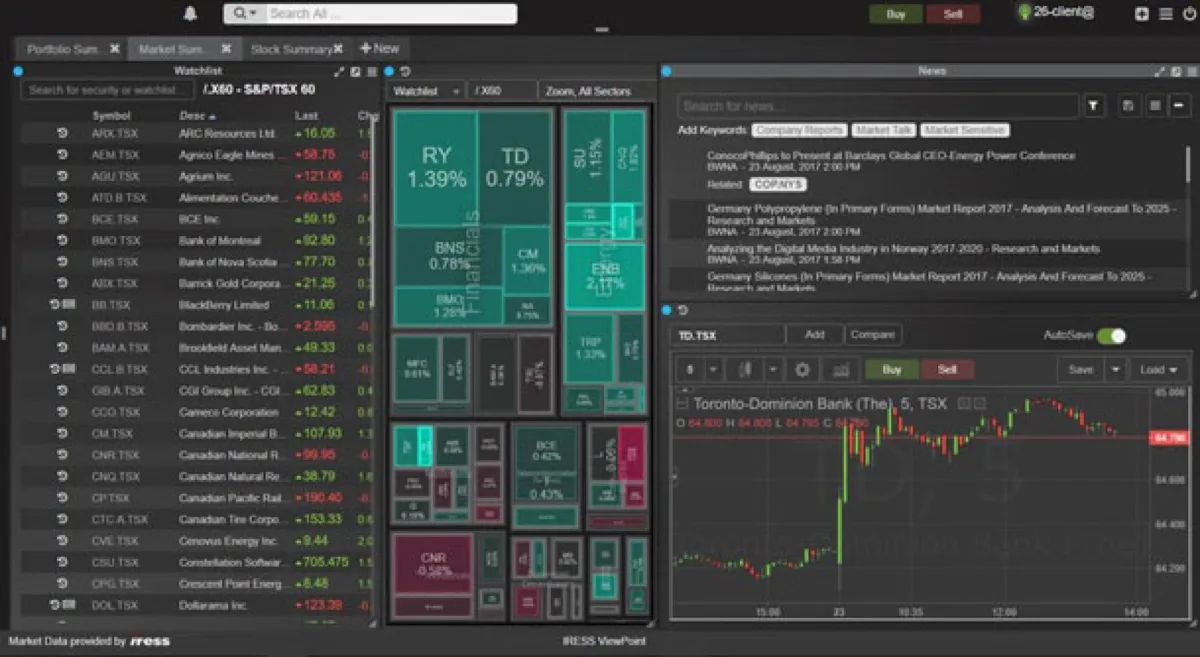
- IRESS: a platform built for trading shares and equity derivatives, with Level 2 data (the depth of pending orders at each price), real-time charts and advanced portfolio tools. Few international brokers offer IRESS, so this is a clear advantage.
- TradingView: clients can link their FP Markets account to TradingView, analysing on its polished charts and placing orders without switching windows.
- WebTrader: trade directly in the browser with nothing to install, handy when travelling or on a public computer.
- Mobile app: runs on iOS and Android with a clean layout, enough to open and close trades, view the portfolio, deposit or withdraw and message support.
On infrastructure, FP Markets' servers sit in Equinix NY4, one of the largest financial data centres in the world. Orders therefore execute quickly with little latency, which scalpers and EA users need.
Trading fees
Few brokers are as clear and cheap on fees as FP Markets, especially for traders focused on per-trade cost and capital efficiency. The main charges are:
- Spread: very tight on Raw, from 0.0 pips, with a small commission. Wider on Standard, from about 1.0 pip, but with no commission, which makes it easy for beginners to calculate.
- Commission: the Raw account charges 3 USD per side, or 6 USD per lot round-turn. Compared with peers such as Pepperstone or IC Markets, this is very competitive.
- Swap: charged as at most international brokers, but eligible clients can use the Islamic account to avoid it.
- Withdrawal fees: Neteller or Skrill may cost 1 to 10 USD depending on the channel, while international wire transfers usually carry extra bank charges.
- Inactivity fee: none, so a trader who takes a break is not charged.
- Hidden fees: no significant hidden fees or unfair terms have been found, which is why the broker is praised for transparency.
Overall, low fees and simple pricing make the broker a good fit for cost-conscious traders, particularly scalpers, EA users and short-term traders. Those who want to understand the two main cost types can read the guide to spread vs commission.
Deposits and withdrawals
FP Markets has many funding channels with fast processing and flexibility for clients in many countries. Even so, Vietnamese traders should keep a few points in mind:
- Deposit channels: Mastercard or Visa cards, international wire transfers, e-wallets (FasaPay, Neteller, PerfectMoney, Skrill, Sticpay) and some local payment gateways in Southeast Asia. The broker charges no deposit fee, which gives traders more control at the start.
- Withdrawal channels: the same channels, but processed a little more slowly. E-wallet withdrawals usually arrive the same day, while bank withdrawals can take 1 to 3 business days.
- Withdrawal fees: the broker itself charges nothing, but e-wallets or intermediary banks may take conversion or transfer fees of 1 to 25 USD. Traders should check this before choosing a withdrawal channel.
- Exchange rate: when depositing in VND or withdrawing to a Vietnamese bank, the conversion rate is reasonable, but it is still worth watching to avoid losing small amounts for no reason.
- Processing time: withdrawal requests are processed automatically and fairly quickly during business hours on working days, while requests sent at weekends or on holidays usually have to wait.
The withdrawal fee figures in the fee section and the funding section may look different at first glance, but they follow the same logic. FP Markets does not charge withdrawal fees itself; the 1 to 10 USD on e-wallets or up to 25 USD through banks are fees of the payment providers in between.
FP Markets strengths
The broker's main strengths can be grouped as follows:
- Multiple licences: ASIC in Australia, CySEC in Cyprus and FSA in Saint Vincent, giving international clients a high level of confidence.
- Low cost: Raw spreads from 0.0 pips and a commission of just 6 USD per lot, well suited to scalping and robots.
- Many platforms: MT4, MT5, IRESS, WebTrader, the mobile app and the TradingView connection, enough for every level.
- More than 10,000 CFDs: currencies, shares, indices, commodities, crypto, ETFs, bonds and options.
- No strategy restrictions: scalping, hedging, EAs and copy trading are all allowed.
- No inactivity fee: a few months away from trading leaves the balance untouched.
- 24/7 support via live chat, email and an international phone line, with fast, professional replies.
- A minimum deposit of just 100 USD, affordable for beginners.
FP Markets weaknesses
On the other hand, the broker has some drawbacks Vietnamese traders should weigh:
- Thin support for Vietnamese clients: there is no official Vietnamese website and no Vietnamese-speaking support staff, which is hard for those with limited English.
- Costly bank withdrawals: some channels cost 10 to 25 USD per withdrawal, especially international wires or less common e-wallets.
- Limited education: there are some guides and webinars, but the library falls short of those at Exness or IC Markets.
- No US clients: this is a legal restriction, but traders should also take care if their IP address or payment method is linked to the US.
- IRESS needs a large balance: using this platform requires at least 1,000 USD in the account, so it does not suit small accounts.
These weaknesses are not serious and mostly concern the user experience in the Vietnamese market. For experienced traders who are comfortable communicating in English, they are entirely acceptable.
Is FP Markets a scam
So far there is no credible evidence that FP Markets defrauds its clients. The broker is authorised and supervised by several major regulators, among which ASIC and CySEC are known for their strictness. A few more reasons help it keep traders' trust:
- Client money is kept separate and the broker may not use it for anything else, a top criterion when judging safety.
- There are no hidden fees, no spread traps and no murky leverage tricks.
- Online complaints, where they exist, mostly stem from misunderstanding withdrawal fees, slow execution caused by the user's own connection, or not reading the terms in full.
- Every day, many traders in Vietnam and abroad trade with the broker without trouble, most of them in forex and share CFDs.
Even so, as with any international broker, traders still need to protect themselves. Specifically, they should only sign up and log in through the official website to avoid fake copies, be wary of introducing brokers (IBs) who act in bad faith, and read the attached conditions carefully, particularly around bonuses or high leverage. What an IB does and does not do is explained in the guide to what an IB is in forex.
Overall verdict
FP Markets is not as loud as brokers that run heavy advertising, but it has real substance. Strong licences, a broad product range, familiar platforms and low fees all serve serious traders who want to stay for the long term.
It is not perfect, though. The lack of Vietnamese support and bank withdrawal fees that are not yet cheap are two points to factor in. For those who put execution speed, safety and a well-structured trading environment first, FP Markets is a choice worth considering.
Sources
- FP Markets, official website (licences, accounts, fees, platforms, funding); traders should recheck here as conditions can change: https://www.fpmarkets.com/
- Australian Securities and Investments Commission (ASIC), licence search: https://asic.gov.au/
- Cyprus Securities and Exchange Commission (CySEC): https://www.cysec.gov.cy/
- Financial Sector Conduct Authority of South Africa (FSCA): https://www.fsca.co.za/
- Financial Services Authority, Saint Vincent and the Grenadines: https://svgfsa.com/
- DCtoptrade (screenshots): https://dctoptrade.vn/


