
XTB Review 2026
XTB review 2026: FCA, KNF, CySEC and IFSC licences, Standard and Pro accounts, fees against IG and eToro, funding from Vietnam, xStation 5 and support.
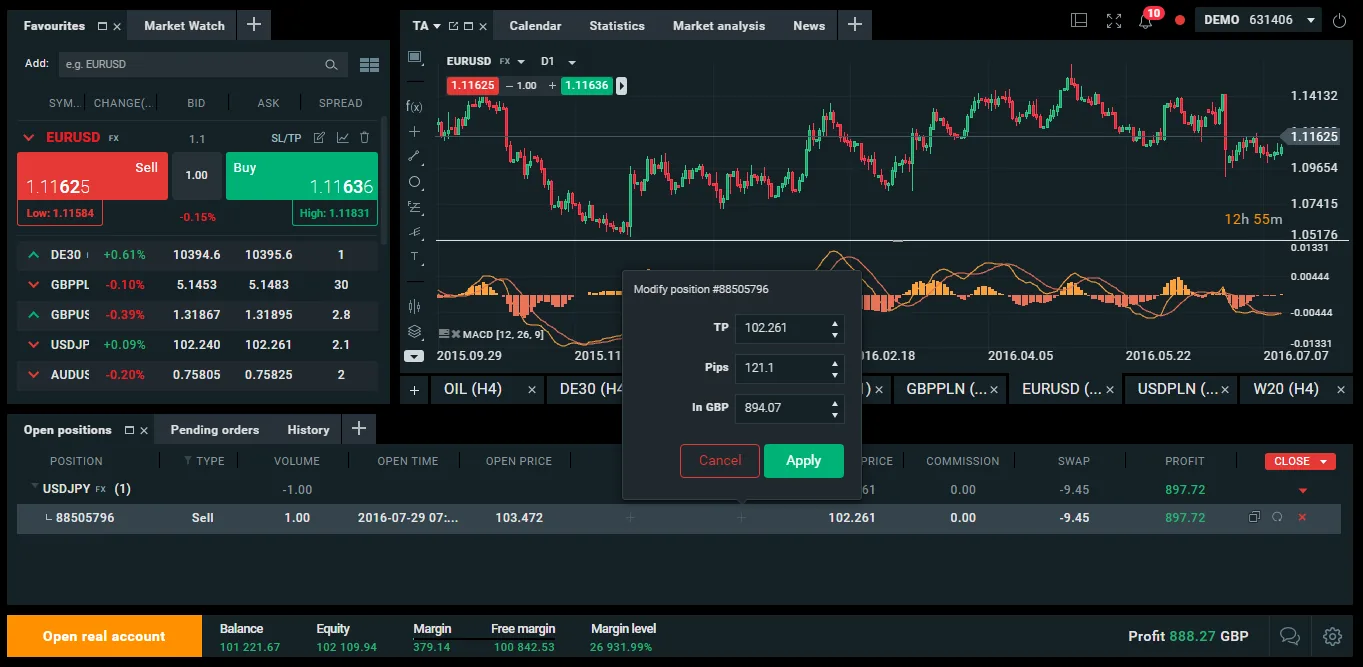
XTB is one of the few forex brokers whose shares are listed on a stock exchange, and it is also a long-established name holding a licence from the UK's FCA. Those two facts create an impression of trustworthiness from the outset, but Vietnamese traders need to know more practical things as well: which account suits them, whether the fees are really high or low, how convenient deposits and withdrawals are, and how the rights of clients outside Europe differ from those of clients inside the EU. The answers to those questions do not always fall on the favourable side.
The sections that follow cover the broker's background and licences, its two account types, its fees, funding from Vietnam, the xStation 5 platform, the product range and client support. Trading conditions such as fees, spreads, leverage and payment channels can change over time, so traders should check them on XTB's official website before opening an account.
What XTB is
XTB is a forex and CFD broker with head offices in two cities, London (United Kingdom) and Warsaw (Poland). A CFD, or contract for difference, is a contract that lets a trader gain or lose from price movements without owning the underlying asset. The broker was founded in 2002, which means it has now been operating for more than two decades, a long time in retail brokerage.
XTB's business is supervised by four financial authorities. They are the FCA in the United Kingdom, the KNF in Poland, CySEC in Cyprus and the IFSC in Belize. In addition, XTB's parent company is listed on the Warsaw Stock Exchange, so it must publish regular financial reports like any public company. Very few forex brokers accept this extra layer of transparency.
Before going into detail, the broker's main strengths and weaknesses can be summarised as follows:
- Fast deposits and withdrawals, with most channels free of charge.
- A simple account opening process that does not take long.
- Client support that responds quickly through chat and phone.
- A licence from the FCA, one of the strictest regulators.
- Low spreads.
- No guaranteed stop loss.
- No support for automated trading with robots (EAs).
The list above is only an overview. The following sections explain each point, including places where a strength comes with conditions.
XTB's strengths and weaknesses
XTB's clearest advantage for Vietnamese traders is fast funding, with withdrawals processed in about 24 hours on average. In addition, trading fees are very low and the broker charges no hidden fees, meaning charges that are not stated in the fee schedule. Registration is also quick and does not involve many steps.
However, the broker has some weak points that are worth knowing in advance. Share trading fees at XTB are high, and the product range revolves mainly around CFDs and forex. Real shares and real ETFs, the kind an investor actually owns rather than merely trades on price, are only available to some clients in Europe.
Another weakness lies in email support. There have been reports of messages sent to the support team several times without a reply, in contrast with the fairly quick responses on chat and phone. When something urgent needs resolving, traders should therefore use live chat or call rather than rely on email alone.
The Standard and Pro accounts
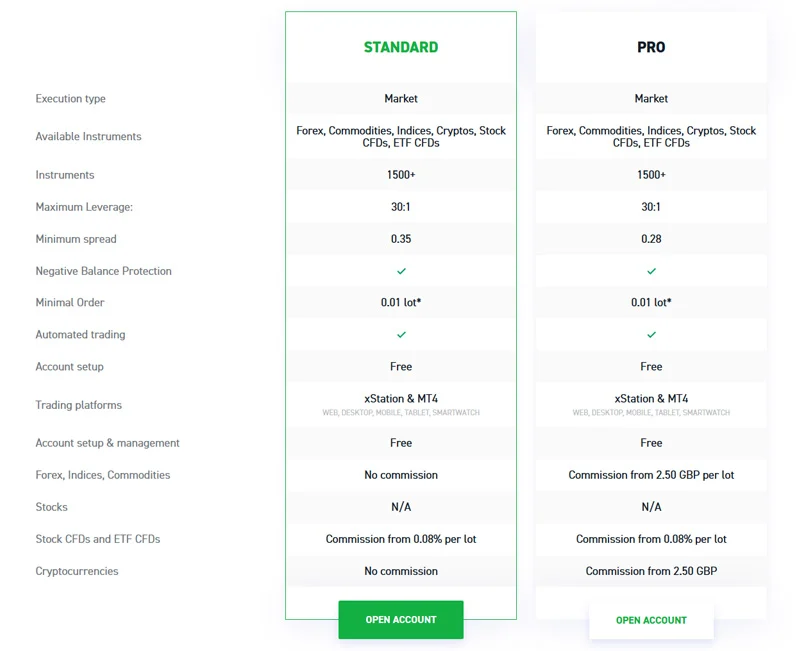
XTB offers just two account types, which differ in how the broker earns money on each trade. The Standard account charges no commission and builds the cost into the spread, the gap between the buy and sell price, so its spreads are wider. The Pro account works the other way round, with tighter spreads but an added commission, and each trade must be at least 0.1 lot.
The Standard account
XTB's Standard account works much like the Standard accounts at familiar brokers such as IC Markets, FBS, XM or Tickmill. The difference is that XTB splits it into three tiers, Standard A, Standard B and Standard C, which differ mainly in spread. Of the three, Standard A has the lowest spread and is usually recommended for beginners. The key specifications of the Standard account are:
- Minimum deposit: USD 1.
- Maximum leverage: 1:500.
- Spread type: floating, meaning it moves with the market.
- Spread: 0.35 pips.
- Commission: none.
- Minimum trade size: 0.01 lot.
A minimum deposit of just USD 1 and a minimum trade size of 0.01 lot make Standard easy to access for traders with little capital. Note that 0.35 pips is the figure the broker states for this account, while in the general comparison Standard is still regarded as the account with wider spreads than Pro.
The Pro account
Pro is aimed at professional traders who trade forex frequently. The broker charges a commission of USD 7 per lot, but in exchange spreads are quite low, so the overall cost favours traders who place many orders. The point to watch is that the minimum trade size rises to 0.1 lot, which is not small for beginners or less experienced traders. The specifications of the Pro account are:
- Minimum deposit: USD 20.
- Maximum leverage: 1:500.
- Spread type: floating.
- Spread: 0.1 pips.
- Commission: USD 7/lot.
- Minimum trade size: 0.1 lot.
Choosing between these two pricing models comes down to adding spread and commission together, as the piece on Standard vs Raw Spread accounts shows with worked examples.
Trading fees
Compared with brokers that have a similar model, such as IG and eToro, XTB is regarded as having low trading fees. Fees follow the account type described above: the Standard account pays only the spread, while the Pro account pays both spread and commission. Even with the extra commission, Pro keeps tight spreads, which makes it a good fit for experienced traders. Both kinds of fee are explained in detail in spread vs commission.
A CFD and forex fee test
To compare costs between XTB, IG and eToro, one test simulated the same buy (long) position held for one week at all three brokers. For CFDs, the test used USD 2,000 of margin, with 20:1 leverage on indices and 5:1 on shares. For currencies, margin was USD 20,000 and leverage 30:1. The results showed XTB to be cheaper for currency and index trading but more expensive for shares. That is also why share fees are listed among the broker's weaknesses.
Other fees
XTB charges no inactivity fee, the charge some brokers deduct when a client has not traded for a long time. Set against its two rivals, the difference is clear. IG charges USD 12 a month once an account has been dormant for two years, and eToro charges USD 10 a month. On top of that, XTB charges no account maintenance fee and waives most deposit and withdrawal fees, with a few exceptions covered in the next section.
Deposits and withdrawals from Vietnam
XTB does not offer many payment gateways, but they are still enough for traders in Vietnam. The current channels are:
- The Ngân Lượng e-wallet.
- Visa card.
- The Skrill e-wallet.
- The Neteller e-wallet.
- Bank transfer.
Deposit fees vary by channel. Deposits through Ngân Lượng and Visa are free, while Skrill charges 2% and Neteller 1%. Among these options, Ngân Lượng is usually the most convenient for Vietnamese clients, because money arrives quickly, there is no fee and help is immediately available since it is a domestic e-wallet.
Deposits can be made in two places. The first is the trading account management area on the XTB website. The second is directly inside the xStation platform, which brings together enough tools for a trader to manage funds and trade without switching between pages.
Withdrawals come with more restrictions. Withdrawal requests are also created in the account management area or on xStation, but money can only be sent to a bank account, as the broker does not yet allow withdrawals through Ngân Lượng or other gateways. In addition, XTB charges a USD 30 fee on each withdrawal below USD 50. Traders should therefore wait until they have at least USD 50 to withdraw, so that the fee does not eat up nearly the whole amount.
In return, the broker does not limit the amount or the number of deposits and withdrawals per day. If a transfer is blocked by a limit, traders should first check with their own bank, because the restriction most likely sits on the bank account rather than with XTB.
The xStation 5 platform
XTB's main platform is xStation 5, software developed in-house by the broker. At first glance its interface looks very professional, as if it were meant only for seasoned traders. In practice, xStation is quite easy to use and has enough features for every level, so beginners can get used to it quickly.
Another strength of xStation is that it runs on many devices, including web browsers, phones and computers. Because it runs directly in a browser, traders can trade from any machine without installing software, a convenience often mentioned in comparisons with MetaTrader. The platform's key features are summarised in the following subsections.
Trading signals
XTB provides trading signals, suggestions for entry and exit points, to its clients. The limitation is that most signals target short-term trades and rely only on technical analysis, so they do not suit traders who follow fundamental analysis or hold positions for a long time.
Charts and indicators
Charting on xStation is well regarded. Traders can customise the layout as they wish and use the 35 technical indicators built into the platform without installing anything extra.
News and economic calendar
XTB provides free market news compiled by the broker's own team of analysts. Its economic calendar, which lists when important macroeconomic data will be released, was ranked best by Bloomberg's EMEA FX Forecaster in 2018.
Market sentiment and stock scanner
The market sentiment tool shows the ratio of XTB clients holding buy positions to those holding sell positions on each symbol. Alongside it, the stock scanner lets traders combine 15 different parameters to filter shares that match their criteria before making a decision.
Mobile apps and desktop version
Both xStation 5 and MetaTrader 4 have apps for iOS and Android phones, and traders can also follow their accounts on an Apple Watch. For desktops and laptops, xStation 5 has a dedicated version whose functions and design are identical to the web version.
Licences and safety
As noted, XTB is supervised by several financial authorities. They are the UK Financial Conduct Authority (FCA), the Cyprus Securities and Exchange Commission (CySEC), the Polish Financial Supervision Authority (KNF) and the International Financial Services Commission of Belize (IFSC). Each licence is tied to a separate legal entity, so the protection a client receives depends on the company named in the contract.
In Europe, XTB operates through two main entities, XTB Limited and X-Trade Brokers Dom Maklerski SA. Under XTB's rules, only clients in certain countries are covered by deposit insurance through these entities. Unfortunately, Vietnam is not on that list, so if the broker ran into trouble, Vietnamese clients would have no fund compensating them directly.
Similarly, XTB applies negative balance protection under FCA rules for forex and CFD trading. Negative balance protection means that when losses exceed the money in the account, the broker resets the balance to zero instead of asking the client to cover the shortfall. However, this protection is only for investors in the European Union, so Vietnamese clients need to control risk themselves through position size and stop losses.
Even so, in terms of overall reputation, XTB is among the easiest brokers to assess. Continuous operation since 2002 and a listing on the Warsaw Stock Exchange are two strong pieces of evidence, because a public company has to disclose its finances and faces far closer scrutiny than a private broker. Traders who want to compare safety with other brokers can see how legal entities are read in the Pepperstone review.
Tradable products
On XTB, traders can trade currencies, indices, shares, commodities, bonds and cryptocurrencies. The list looks broad at first sight, but compared with IG and eToro, how rich it really is depends on the asset class and on the client's region.
One inconvenience is that traders cannot change the default leverage on each product themselves. That is a drawback, because each asset class moves differently, so leverage ought to be adjustable to match each trader's experience and risk appetite. How leverage affects an account is explained in forex leverage for beginners.
Real shares and real ETFs are only open to investors in Europe, excluding the United Kingdom, Cyprus, Hungary and Italy. As a result, Vietnamese clients mainly trade these products as CFDs.
Client support
When they need help, XTB clients can contact the broker through three channels. They are live chat, phone and email.
The broker now offers Vietnamese-language support on many channels. The chat and phone teams respond quickly and helpfully and usually resolve issues cleanly. By contrast, as mentioned under weaknesses, the email channel is sometimes slow or does not reply, so matters that need immediate attention should go through chat or phone.
Verdict
XTB is a leading reputable forex broker, with a long track record and licences from several well-known financial authorities such as the FCA. The broker has also won many industry awards in forex. Its standout strengths are low fees on currencies and indices, fast and convenient funding from Vietnam, and a simple account opening process.
On the other hand, share trading fees are fairly high, and many products such as real shares and ETFs are not open to Vietnamese clients, because the broker mainly serves European investors. Even so, for traders who only need currencies, commodities and cryptocurrencies, XTB remains a choice well worth considering. The content here is for reference only and is not investment advice.
Sources
- XTB, official website, https://www.xtb.com/ — where account types, fees, payment channels and legal entities are published; traders should check again there because conditions can change.
- UK Financial Conduct Authority (FCA), Financial Services Register, https://register.fca.org.uk/
- Polish Financial Supervision Authority (KNF), https://www.knf.gov.pl/
- Cyprus Securities and Exchange Commission (CySEC), https://www.cysec.gov.cy/
- International Financial Services Commission of Belize (IFSC), https://www.ifsc.gov.bz/
- Images: DCtoptrade (screenshots): https://dctoptrade.vn/


