
Forex Brokers for Small Accounts 2026
Choosing a Forex broker with little capital in 2026: what a small account means, six criteria from minimum deposit to lot size, Exness, XM, Valetax, Vantage.
Many people come to Forex with the same wish: deposit a very small amount, yet still place real-money trades in order to learn the craft. As a result, they often start by hunting for the broker with the lowest deposit. That reasoning is understandable, but if traders look only at the initial deposit and ignore trade size, costs and leverage, a small account can quickly slide into high risk and get out of control.
The sections that follow explain what a "small account" usually means, the conditions a broker needs to suit one, six comparison criteria, four brokers that low-capital traders often choose, a quick comparison table and how rebates can cut costs. Trading conditions can change at any time, so traders should recheck them on each broker's official website before opening an account.
Trading Forex with little capital
What counts as a small account
There is no single figure that defines a small account for everyone. In practice, the common understanding rests on two things: an amount low enough that a new trader can accept losing it, and a main goal of learning to trade in a live market rather than maximising profit.
For that reason, small accounts are usually tied to a specific stage of learning. It is the point at which a trader:
- Leaves the practice (demo) account and moves to a live one.
- Learns to stay calm while a position runs on their own money.
- Gets used to spread, slippage and the real costs a demo account does not show clearly.
Pros and cons of a small account
Trading with little capital has clear upsides and clear downsides. On the plus side, the amount that can be lost is small in absolute terms. Moreover, traders learn in real conditions, and the very lack of capital forces them to take risk management seriously from the outset.
On the other hand, a small account has three worrying weaknesses:
- Trading costs are large relative to the balance, so they erode the account quickly.
- High leverage easily creates heavy psychological pressure.
- One small mistake can wipe out a very large percentage of the account.
Why the broker matters more with little capital
With little capital, the margin for error is very narrow. A few details that look minor have an outsized effect. If the minimum trade size is too large, the trader is pushed into heavier positions than they should take. If each trade costs a lot, the balance is steadily worn down. And if the platform is unreliable, slippage distorts the result of every trade.
It follows that, for a small account, choosing the right broker and account type matters even more than choosing a strategy. A good strategy still struggles to survive on an account whose trading conditions do not fit.
What a "small-account broker" really means
More than a low deposit
A common mistake is to think that finding the broker with the lowest deposit is enough. In reality, a broker that suits a small account has to meet three conditions at once:
- It allows very small trade sizes.
- Its trading costs are moderate.
- Its execution is stable.
If any of the three is missing, a low deposit loses most of its value. For example, depositing USD 10 but being forced to open large positions or pay high fees still leaves the account very likely to blow up.
Account types for low-capital traders
The market offers three kinds of account that are commonly used to support small traders. The first is the cent account, where the balance and trades are counted in cents, so the value of each trade is many times smaller, which eases the pressure of a first live account. The second is a micro or standard account with a low minimum trade size. The third is any account that does not demand much margin to keep positions open.
Each kind has its own strengths and limits. Traders should therefore read the conditions of each type before choosing, rather than opening whatever default account the broker suggests.
Four common misconceptions
Many small accounts lose money not because of the market but because of four mistaken beliefs:
- Paying attention only to the minimum deposit and ignoring the trading conditions attached.
- Believing that the higher the leverage, the easier it is to profit.
- Not accounting for spread and commission.
- Assuming that a small account does not need serious risk management.
These beliefs lead straight to overtrading, and capital disappears very quickly. The six criteria that follow help avoid each of those traps.
Six criteria for choosing a broker with little capital
Minimum deposit
A low minimum deposit makes it easier to start, but it should not be the only criterion. The extra questions to ask are whether that deposit comes with restrictions on account type or products, and whether the amount is enough to manage risk sensibly.
Minimum trade size
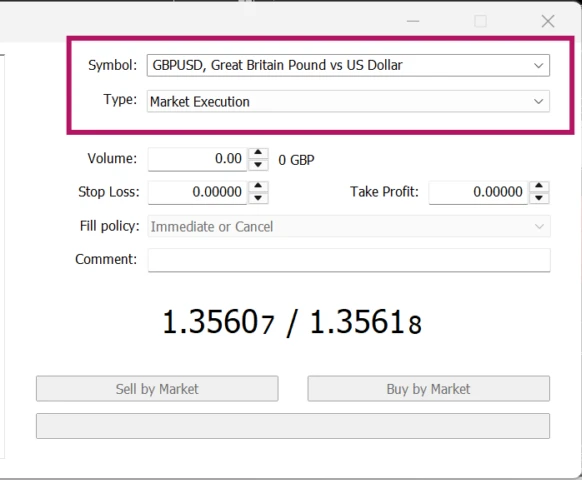
The minimum trade size directly decides how much each trade can lose. The smaller the minimum, the easier it is for the trader to keep risk within limits. Conversely, if the broker sets a large minimum, a low-capital trader is forced to take more risk than necessary. This criterion is often overlooked even though it matters a great deal; how lots convert into pip value is explained in lots, pips and pip value.
Leverage and margin
Leverage, the ratio between the value of a position and the margin put up for it, is what lets small traders take part in the market. However, it is also the leading reason small accounts vanish within a few sessions. High leverage does not mean high efficiency, so what matters is whether the broker lets traders choose a level they can handle. Forex leverage for beginners explains the mechanism in detail.
Trading costs
Costs weigh far more heavily on a small account than on a large one. A wide spread pushes the break-even point further away, while a fixed per-lot commission easily becomes a burden for traders who place many small trades. That is why traders should look at the total cost of a trade rather than trusting "low spread" advertising; how to add the two together is shown in spread vs commission.
Platform stability
Small accounts tend to place small trades, but that does not make execution quality any less important. When a broker executes poorly, slippage moves the entry away from the plan, and a stop loss can be hit even when the price only spikes briefly.
Reputation and transparency
Little capital is no reason to accept risk on the broker's side. A transparent broker lets traders deposit and withdraw with confidence. In addition, clearly written trading conditions help avoid misunderstandings and disputes later on.
Four brokers low-capital traders often choose
The four brokers below come up often in discussions about small accounts, and each suits a different type of beginner. The figures are what the brokers publish and can change, so traders should check them again on the official websites.
Exness
Exness is chosen by many low-capital traders because its entry conditions are fairly easy. The figures most relevant to a small account are:
- A published minimum deposit of about USD 10.
- A minimum trade size of 0.01 lot.
- Flexible, trader-selected leverage.
- Swap-free (no overnight fee) accounts for some products.
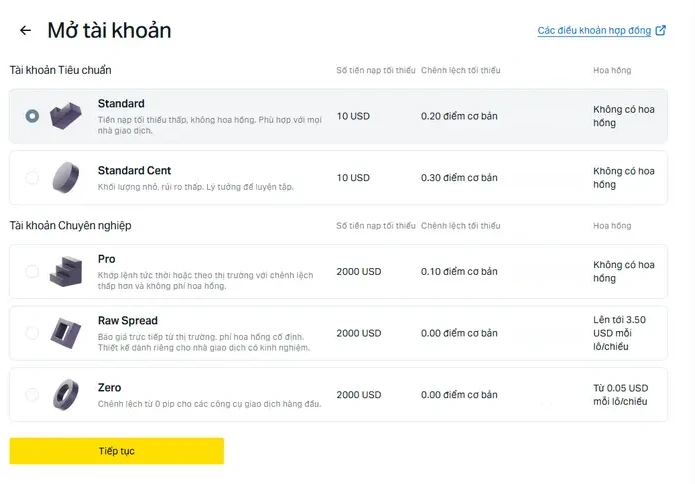
For beginners, these figures have concrete meaning. With just USD 10–50, a trader can still place small trades with a sensible stop loss, and the 0.01-lot minimum keeps the risk of each trade within reach. Exness therefore suits the move from demo to live trading. The points to watch are that high leverage easily leads beginners to overtrade, and that spreads can widen when the market moves sharply. More on the broker is in the Exness review.
XM
XM aims at a stable trading environment that is easy for newcomers to access. The notable figures are a published minimum deposit of about USD 5, a Micro account for small trade sizes, and leverage that is adequate for low-capital traders.
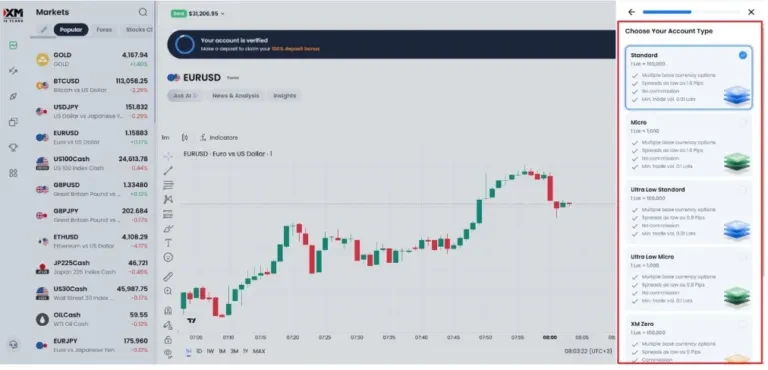
Thanks to the low deposit, traders can try live trading with a very small initial outlay, while the Micro account reduces the risk on each trade. XM therefore suits traders who value stability over fast in-and-out trading. On the other hand, its spreads are not the lowest on the market, and it is not optimised for high-frequency scalping. The account opening steps are covered in opening an XM account.
Valetax
Valetax attracts traders with very little capital thanks to its low entry threshold. According to the broker, the minimum deposit starts from USD 1 depending on the account type, there is a cent account that shows the balance in cents, and the minimum trade size is small.
These conditions suit traders who want to practise with a genuinely small amount. In addition, the cent account eases the pressure of the first live trades, and risk is easy to control during the learning stage. Even so, Valetax spreads are only average, and traders should read the conditions of each account type carefully. BackcomHub currently has no rebate programme with this broker; more information is in the Valetax review.
Vantage
Vantage aims for a balance between cost and execution quality. The common minimum deposit is about USD 50, the minimum trade size is 0.01 lot, and the broker offers both Standard and Raw accounts for different trading styles.
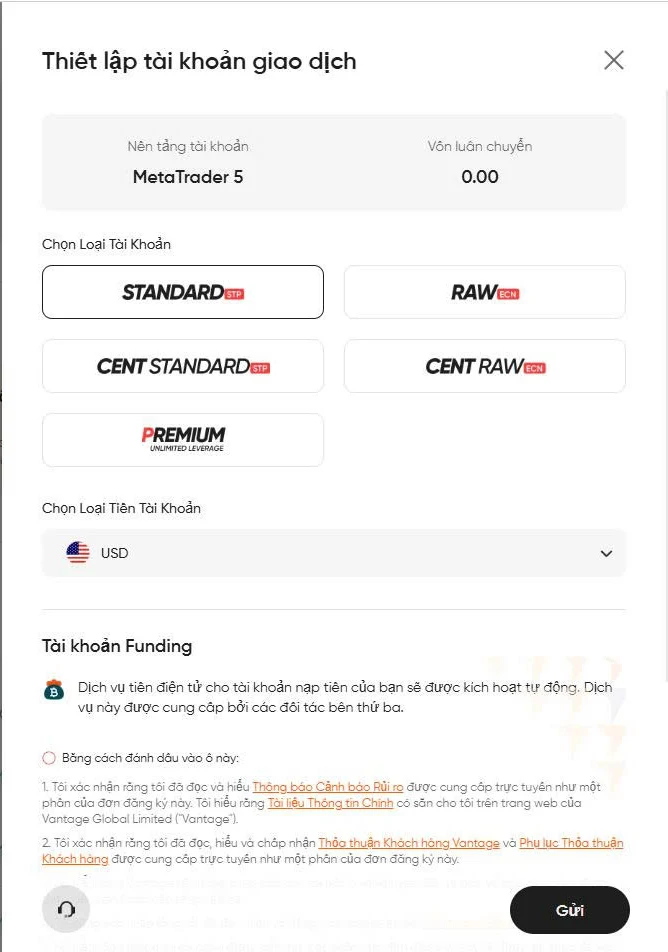
With USD 50 or more, a trader can trade with discipline at Vantage, and the 0.01-lot minimum keeps risk low. The broker therefore suits traders who already have the basics. However, Vantage is not a good fit for very small balances below about USD 20, and traders who place many small trades need to watch costs closely. Full details are in the Vantage review.
Quick comparison of the four brokers
The table below groups the four brokers by the three angles low-capital traders care about most:
| Angle | Valetax | XM | Exness | Vantage |
|---|---|---|---|---|
| Suitable capital | Very small | Small to medium | Small to medium | Small, but a slightly higher first deposit |
| Low-risk tool | Cent account | Micro account | Low minimum trade size | Low minimum trade size |
| Learning money management | – | Good fit | Good fit | – |
| Best for | Complete beginners | Complete beginners | Beginners who want flexibility | Traders with the basics |
Reading across the rows, Valetax leads on low capital requirements, while XM and Exness are seen as good places to learn money management. Meanwhile, Vantage is the next step once a trader has solid foundations.
Rebates for small accounts through BackcomHub
On a small account every dollar of cost counts, so a rebate (backcom) is one way to recover part of it. Specifically, the broker pays commission to an introducing broker (IB), and the IB passes part of it back to the trader for each lot traded, as explained in what is backcom.
Disclosure. BackcomHub is an IB of the brokers in the table below and receives IB commission from them on accounts registered through BackcomHub.
Rebate rates for the account types most used with little capital, in USD per lot, from the BackcomHub rebate table:
| Broker | Account type | EUR/USD | Gold XAU/USD | Referral code | Data as of |
|---|---|---|---|---|---|
| Exness | Standard & Cent | 3.20 | 9.60 | oc9jb1aix4 | 20/11/2026 |
| XM | Standard & Micro | 8.10 | 15.30 | BACK100 | 10/11/2026 |
| Vantage | Standard | 6.12 | 18.00 | HOAN100 | 10/11/2026 |
On cent or micro accounts, each trade is smaller than a standard lot, so traders should ask exactly how volume is converted when the rebate is calculated before relying on the figures in the table. In addition, a high rebate does not make an account cheaper if the spread is already wide, so the number to compare is the net cost, as shown in Standard vs Raw Spread accounts. Broker details are in Exness rebates, XM rebates and Vantage rebates; traders with an existing account can read how to switch IB.
Frequently asked questions
How much capital is needed to start trading Forex?
Technically, traders can start with a very small amount. However, it should be enough to place a sensible stop loss and survive a short losing streak without blowing the account.
How much should a beginner deposit?
A common choice is about USD 50–200. That range is enough to learn disciplined trading while keeping psychological pressure bearable.
Which brokers suit small accounts and are still reputable?
Exness and XM are often chosen by low-capital traders. The reason is that both publish their conditions clearly and are easy to access.
Should high leverage be used on a small account?
No, because high leverage increases risk much faster than potential profit. Traders with little capital need to keep leverage moderate all the more.
Can a small account make a profit?
It can, but the main goal at this stage should be building skill and managing risk. Expecting big gains in a short time usually leads to overtrading.
When should capital be increased?
Only once the trader has a stable trading plan and keeps risk within limits. If results are still erratic, adding capital only makes losses bigger.
Key takeaways
No broker is best for everyone; there is only the broker that fits each trader's capital and goals. When choosing a broker for a small account, what decides long-term results is still risk management and discipline, not the size of the first deposit. Traders should therefore weigh all six criteria above and then recheck the conditions on the official website before depositing.
Sources
- BackcomHub rebate table, data from dctoptrade.vn: Exness as of 20/11/2026, XM and Vantage as of 10/11/2026.
- Official broker websites, where traders should recheck minimum deposits, minimum trade sizes, leverage and account types: https://www.exness.com, https://www.xm.com, https://www.valetax.com, https://www.vantagemarkets.com.
- DCtoptrade (screenshots): https://dctoptrade.vn/


