
Tickmill Review 2026
Tickmill review 2026: group entities and licences, entity for Vietnamese clients, Classic vs Raw costs, Dynamic Leverage, platforms, VND funding and support.
More than ten years have passed since Tickmill began offering forex and CFD brokerage to clients around the world. The broker is known for low fees and for allowing trading styles that many others restrict, such as very fast scalping, opening opposite positions to hedge, or letting a robot trade (EAs). Even so, before looking at fees, Vietnamese traders should answer a different question: which company in the group will hold their account, and who supervises that company.
The sections that follow look at the group's companies and licences, how the broker holds client money, the Classic and Raw accounts, each type of fee, leverage and margin, the product range, platforms, funding and support. Most figures are what Tickmill published as of August 2026. Conditions can change at any time, so traders should re-check them on Tickmill's official website before opening an account.
What Tickmill is
Tickmill was founded in 2014 with two core lines of business, forex and CFDs. A CFD, or contract for difference, lets a trader gain or lose from an asset's price without owning the asset. Today the brand operates through a group of companies called Tickmill Group, with each company serving clients in its own legal jurisdiction. Tickmill's own awards page also lists 2014 as the year the brand started operating.
In terms of scale, the figures Tickmill gave up to August 2026 are substantial. The whole group has more than 1.35 million registered accounts, clients place on average about 16 million trades a month, and headcount exceeds 330 people across several countries. With that many years and clients behind it, Tickmill has enough operating history for traders to judge it on its record rather than its advertising.
Licences and reputation
A group of companies, each with its own licence
The first thing to understand when assessing Tickmill is that the brand does not sit in a single company. The group has several entities, and each holds a licence where it operates. According to the list on its official website, the key entities are:
| Region served | Company | Regulator | Licence number |
|---|---|---|---|
| International clients | Tickmill Ltd | Seychelles Financial Services Authority (FSA) | SD008 |
| United Kingdom | Tickmill UK Ltd | Financial Conduct Authority (FCA) | 717270 |
| European Union, based in Cyprus | Tickmill Europe Ltd | Cyprus Securities and Exchange Commission (CySEC) | 278/15 |
| South Africa | Tickmill South Africa (Pty) Ltd | Financial Sector Conduct Authority (FSCA) | FSP 49464 |
| Dubai | Representative office of Tickmill UK Ltd | Dubai Financial Services Authority (DFSA) | F007663 |
The table shows a broad legal footprint, from two major financial centres, London and Cyprus, to South Africa and Dubai. However, a licence only protects clients who contract with the company holding it. What Vietnamese traders really need to know, therefore, is which company they end up with.
The company that contracts with Vietnamese clients
This is the most important detail in the whole review. As of August 2026, the Vietnamese version of the website states that Tickmill is the trading name of Tickmill Ltd, a group member supervised by the FSA in Seychelles. The Vietnamese Contact Us page likewise names Tickmill Ltd with the Seychelles FSA as the entity serving clients of the international website.
Further evidence sits in the Legal Documents section of the international website. It contains the Client Service Agreement issued by Tickmill Ltd, and that document itself states that the company is regulated by the Seychelles FSA under licence SD008.
For that reason, anyone in Vietnam who opens an account through the Vietnamese or international website should assume their counterparty is Tickmill Ltd in Seychelles. Country of residence is only a hint, not proof, however. The surest step, before transferring money, is to open the Client Service Agreement in the Client Area and read the company name on it.
How Tickmill holds client money
The broker has a few layers of protection for client funds, but how they apply depends on which company a client belongs to. The first layer is segregated client funds. The international website says client money sits in separate bank accounts, apart from the money the broker uses to run its business, so the company cannot easily use traders' money to pay salaries or rent.
The second layer is a commitment that clients will not end up owing the broker, called Negative Balance Protection. If a sharp price jump pushes remaining equity below zero, the negative part can be written off so the balance returns to zero, under the company's policy and conditions. Within the scope of that policy, traders do not have to pay out of pocket to cover losses beyond their deposit.
The two main accounts
At present Tickmill mainly offers two account types on MetaTrader 4 and MetaTrader 5, Classic and Raw. Both require a minimum first deposit of USD 100, a smallest trade size of 0.01 lots and a choice of four account currencies: USD, GBP, EUR or ZAR. They differ only in how the broker charges: Classic uses wider spreads and no commission, while Raw keeps spreads close to the market and charges commission per lot.
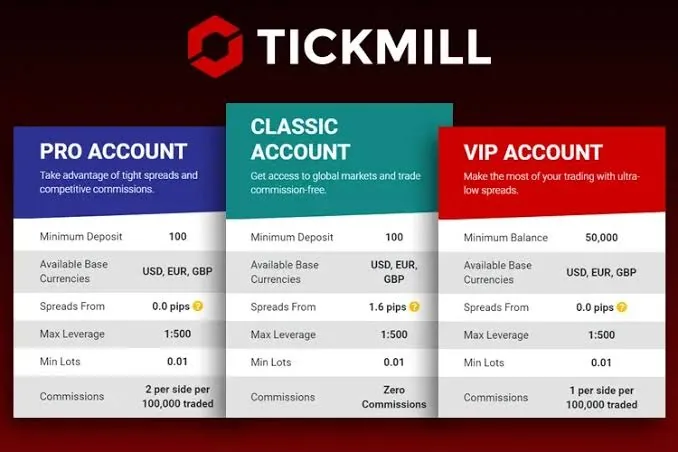
The image shows Tickmill's earlier account table, from when Raw was still called Pro and the broker also had a VIP account. The figures in it are therefore out of date and should only be used to picture how the broker splits accounts by pricing model.
Classic account
On Classic, the broker earns only through the spread, the gap between the buy and sell price, and charges no commission at all. The minimum spread is 1.6 pips, the account opens with USD 100, and clients of the international company can use leverage up to 1:1000, depending on the instrument and position size.
Because every cost is packed into the spread, Classic users can track fees very easily. They do not need to remember to add commission on entry and exit; looking at the spread tells them what they are paying.
The downside of that simplicity is that a 1.6-pip spread is expensive for traders who enter positions all day. Taking EUR/USD as an example, one standard lot has a pip value of about USD 10, so a 1.6-pip spread costs roughly USD 16 per lot. Traders unfamiliar with converting pips into money can read lots, pips and pip value. Classic therefore suits those who want easy-to-understand fees, trade infrequently, or are not yet ready to separate spread and commission on every order.
Raw account
Raw takes the opposite approach, with a raw spread that can reach 0 pips and commission of USD 3 per lot for each side, opening or closing. In other words, one lot traded round trip costs USD 6 in commission. That excludes the spread, and also excludes the overnight fee (swap) if the position is held into the next day.
For EUR/USD, the lowest spread is currently zero and the typical level is about 0.1 pips. Taking a 1-lot EUR/USD trade when the spread is 0.1 pips, the costs add up as follows:
- Spread: roughly USD 1.
- Commission on entry: USD 3.
- Commission on exit: USD 3.
- Total: around USD 7 per lot.
That calculation excludes slippage and swap, and the real spread widens or narrows with liquidity. Even so, next to roughly USD 16 on Classic for the same lot, Raw is clearly cheaper. This tight-spread-plus-fixed-commission model is what makes Raw popular with scalpers, day traders, EA users and high-frequency strategies. The more trades, the larger the cost gap between the two accounts, as analysed in detail in Standard vs Raw Spread accounts.
Besides Raw for MetaTrader, the broker has a variant called TradingView Raw for TradingView and its own Tickmill Trader platform. This variant also has spreads from zero and still opens with USD 100, but commission is higher at USD 3.5 per lot per side, or USD 7 for a full round trip. In addition, the only account currency accepted on this variant is USD.
Trading costs in detail
A trade at Tickmill mainly costs three things: spread, commission and swap. Beyond those, depending on the situation, clients may face a fee when an account sits unused for too long, or charges from banks and payment gateways. Each is covered in turn below, and how spread and commission combine into the real price of a trade is explained in spread vs commission.
Spreads on key instruments
Spreads at Tickmill are floating rather than fixed, meaning the gap between the Ask and Bid price widens or narrows with liquidity. Raw accounts can have zero spreads, while Classic starts at 1.6 pips. The international system currently publishes these levels:
| Instrument | Typical | Minimum |
|---|---|---|
| EUR/USD | 0.1 pips | 0 |
| GBP/USD | 0.3 pips | 0 |
| Gold (XAU/USD) | 0.09 | 0.08 |
| Nasdaq 100 (USTEC) | 1.93 | 0.8 |
| Dow Jones (US30) | 2.52 | 2.2 |
For indices, "typical" is calculated as the median spread during the main trading hours of the last 30 days. It therefore reflects the cost on an ordinary day more accurately than the minimum, which only appears in moments of deep liquidity.
Commission on Raw
On MetaTrader 4 and 5, each lot traded on a Raw account is charged USD 3 per side. Since every trade has an entry and an exit, this doubles to USD 6 per lot round trip.
On TradingView Raw the charge is USD 3.5 per side, so a full round trip costs USD 7 before the spread. Traders choosing between MetaTrader and TradingView purely on cost should include that USD 1 per lot difference in their comparison.
Overnight fees
Swap is the amount credited or debited to a position still open when it passes the switch to a new trading day (rollover). Its size depends on the instrument, on whether the position is a buy or a sell, and on interest rate conditions in the market.
For currency pairs, swap is applied at 00:00 server time. Positions held over Wednesday night are charged three times (triple swap), because the settlement cycle at that point spans Saturday and Sunday. Traders who often hold positions for several days should therefore check the swap table in the platform first.
Funding fees and idle accounts
On many payment channels operated directly by Tickmill, the broker currently charges nothing for deposits or withdrawals. Local bank transfer in VND is also published as free in both directions on Tickmill's side.
On the other hand, Tickmill Ltd does charge when a Client Area is classed as Dormant. A Client Area falls into that category after 12 months and 10 days in a row with no trades, no open positions, no deposits, no withdrawals and no transfers, while the balance remains within the band the broker sets. From then on, the broker charges 10 currency units per quarter for accounts in USD, EUR, GBP or CHF, and PLN accounts pay PLN 40.
Separately from the Client Area, individual trading accounts can also be flagged inactive and archived. This happens after at least 60 days with no trades, positions, deposits, withdrawals or logins, provided the balance is below the set level. Any remaining money is then moved to the Wallet, and the client can still withdraw it as normal.
Leverage and margin
Leverage on Tickmill accounts can be set anywhere from 1:1 to 1:500. Some instruments on MetaTrader 5 and Tickmill Trader can even reach effective leverage of 1:1000 through a self-adjusting mechanism called Dynamic Leverage. The exact figure a client can use depends on the platform, instrument, position size and the company managing the account. To understand how leverage affects margin, beginners can read forex leverage.
Leverage caps by product group
Clients of the international company can usually use up to 1:500. Some currency pairs and gold covered by Dynamic Leverage can go up to 1:1000, provided the total position stays in the smallest tier. The caps by group are:
| Leverage cap | Product group |
|---|---|
| 1:1000 | Currency pairs; gold XAUUSD and XAUEUR |
| 1:200 | Crypto BTCUSD, ETHUSD; indices US30, USTEC, DE40 |
| 1:100 | Oil; round-the-week gold XAUUSD.24-7 |
How Dynamic Leverage works
The mechanism lowers leverage automatically as total open volume grows. Small positions get high leverage, and as a position swells, the volume above each threshold moves to a lower leverage tier. In this way the broker controls the risk from very large positions while still letting small accounts use high leverage.
For currency pairs on the international list, the broker currently uses four tiers:
| Tier | Leverage | Margin required | Open forex volume |
|---|---|---|---|
| 1 | 1:1000 | 0.10% | Up to 2 lots |
| 2 | 1:500 | 0.20% | 2.01 to 200 lots |
| 3 | 1:100 | 1% | 200.01 to 400 lots |
| 4 | 1:10 | 10% | Over 400 lots |
Reading the table in order, a trader with 1 lot open in total stays at 1:1000, while above 2 lots the extra volume moves to 0.20% margin, equivalent to 1:500. Most retail accounts only ever use the first two tiers, and the last two mainly apply to very large volumes.
Margin call and stop out levels
For international clients, Tickmill issues a margin call when the margin level falls to 100% and starts forced closing (stop out) at 30%. The margin level here is equity divided by the margin currently in use, multiplied by 100%.
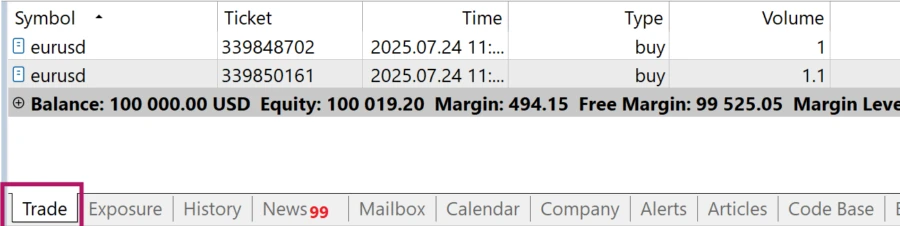
The 100% mark means equity is only just equal to the margin in use, and the account has entered the danger zone. If the level keeps sliding to 30%, the system automatically cuts positions to stop the loss growing.
Product range
In total, Tickmill offers more than 600 CFD instruments across currency pairs, indices, commodities, cryptocurrencies, shares and ETFs. The number a client sees depends on the platform and the managing company. MT4, for example, currently has just over 180 instruments, far fewer than the full catalogue of the international system.
Currency pairs
Forex is Tickmill's core business, with more than 60 pairs including majors, crosses and some exotics. Raw users trade these pairs with spreads that can be zero, and some majors get Dynamic Leverage up to 1:1000 when traded on MetaTrader 5 or Tickmill Trader.
As total exposure rises, the majors and crosses on the Dynamic Leverage list have their leverage reduced automatically. Note that MT4 only has static leverage; the dynamic mechanism runs only on MetaTrader 5 and Tickmill Trader, for eligible symbols.
The forex market is open five days a week and highly liquid, so it suits many trading styles. Because the broker allows scalping, hedging and EAs, both manual traders and automated systems have a place at Tickmill.
Gold, silver and other commodities
The commodity group covers precious metals, energy, agricultural products and industrial metals. Specifically, it includes XAUUSD, XAUEUR, XAGUSD, Brent, WTI, Natural Gas, Copper, Cocoa, Coffee, Sugar and Wheat.
Of these, gold stands out most. XAUUSD and XAUEUR can use Dynamic Leverage up to 1:1000 on MetaTrader 5 and Tickmill Trader, as long as the position stays in the highest-leverage tier.
Stock indices
The broker has more than 20 indices, mainly representing major markets in the US, Europe and Asia. On some account structures, index CFDs carry no commission, and spreads on eligible symbols can be zero.
Each index trades according to the hours of its home exchange. For example, the three US indices US30, USTEC and US500 run almost all day from Monday to Friday, while HK50 and some other Asian indices have breaks during the day.
Crypto CFDs
The crypto group is open at weekends too, 24 hours a day. In the first Dynamic Leverage tier, BTCUSD and ETHUSD can use maximum leverage of 1:200.
Through CFDs, traders can bet on prices rising or falling without buying real coins. However, because this is a derivative, the trader holds no Bitcoin or Ethereum in a blockchain wallet, as they would when buying coins on a crypto exchange.
In addition, coin prices usually swing much more than exchange rates, and spreads can also be much wider. Currently both the minimum and typical spreads on BTCUSD are far higher than on the major pairs, so traders should work out the real cost of each trade before entering.
Share and ETF CFDs
These two groups trade only on MetaTrader 5, currently carry no separate commission and include dividend adjustment. That means when a company pays a dividend, the balance of an open position is credited or debited accordingly.
Traders can place buy or sell orders without holding the real shares. This is therefore not the same as buying stock in the usual way, and the client does not become a shareholder of Apple, Nvidia or any other company. To unlock this product group, clients must also complete the W-8BEN form in the Client Area.
Bonds
Tickmill offers CFDs on German bonds, with a published leverage cap of 1:100. This lets traders follow movements in the debt market without buying the bonds directly. Compared with forex, gold or indices, bonds get less attention from retail traders, but they are useful when an extra direction is needed to spread a strategy.
Trading platforms
Traders at Tickmill have four platforms to choose from: MetaTrader 4, MetaTrader 5, TradingView and Tickmill Trader. Both MetaTrader versions run on desktop, mobile and in the browser (WebTrader). Tickmill Trader, meanwhile, has iPhone and Android apps plus a web version, and TradingView lets traders connect their account directly and place orders on the chart.
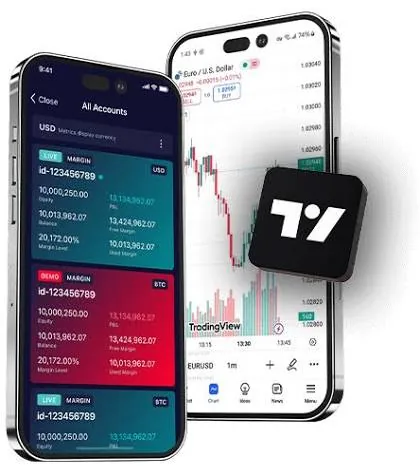
All four platforms accept Raw accounts, all can trade forex and all have both web and mobile versions. The differences lie in the criteria in the table:
| Platform | Classic available | Robots/automation | Dynamic Leverage | Max leverage | Raw commission (per lot, per side) | Built-in indicators | Share/ETF CFDs | Strongest at |
|---|---|---|---|---|---|---|---|---|
| MetaTrader 4 | Yes | EAs in MQL4 | No | 1:500 | USD 3 | 50+ | Limited, not the main venue | Legacy EAs, scalping |
| MetaTrader 5 | Yes | EAs in MQL5 | Yes | 1:1000 | USD 3 | 38 | Yes | Multi-asset, EAs |
| TradingView | No | Pine Script, Strategy | Yes, via the linked account | Up to 1:1000 | USD 3.5 | 400+ | Depends on catalogue | Chart analysis |
| Tickmill Trader | No | Not a main strength | Yes | 1:1000 | USD 3.5 | 60+ | Depends on catalogue | Mobile and web trading |
The table shows that MT4 is still worthwhile for long-time users or those who already own a set of MQL4 EAs. MT5, by contrast, has more products, richer analysis tools and Dynamic Leverage, so it suits most traders who want to stay with MetaTrader long term.
TradingView is strong at drawing and reading charts and has the Pine Script language, but its commission is USD 0.5 per side higher than MetaTrader. Tickmill Trader suits those who trade mainly on mobile or in the browser, and it also acts as the bridge that links an account directly to TradingView.
Combining cost, the ability to run robots and the breadth of the catalogue, MetaTrader 5 is the most balanced of Tickmill's four platforms. Traders who prioritise chart analysis may lean towards TradingView. Anyone with an MQL4 EA running smoothly has little reason to leave MT4.
Deposits and withdrawals
The broker accepts quite a few payment channels: international bank wire, Visa or Mastercard cards, the Skrill and Neteller e-wallets, cryptocurrency, and UnionPay (funding in Chinese yuan, CNY). For clients in Vietnam, the most notable channel is Vietnam Bank Transfer, which allows deposits and withdrawals directly in Vietnamese dong without converting to foreign currency.
Deposits
All deposits go through the Wallets section of the Client Area. A trading account needs at least USD 100 or the equivalent for the first deposit, but some local payment channels have their own limits. The table summarises the main channels:
| Channel | Funds credited | Minimum deposit | Currencies accepted |
|---|---|---|---|
| Vietnam Bank Transfer | Instantly | VND 2,000,000 | VND |
| Visa/Mastercard | Instantly | 100 | USD, GBP, EUR |
| Skrill | Instantly | 100 | USD, GBP, EUR |
| Neteller | Instantly | 100 | USD, GBP, EUR |
| Cryptocurrency | Instantly, including weekends | 100 | USD, GBP, EUR |
| UnionPay | Instantly | CNY 700, or the equivalent of USD/EUR/GBP 100 | CNY |
| International bank wire | About 1 day for the broker to process, 2–7 days to arrive | 100 | USD, GBP, EUR, ZAR |
Vietnamese clients using local bank transfer in VND are therefore credited instantly and pay no fee on Tickmill's side. An international wire, by contrast, can take almost a full week to reach the account.
Withdrawals
To withdraw, clients go to the Client Area, choose Wallets and then Withdraw. Most requests are handled by the broker within one working day.
For most international channels, the smallest withdrawal is 25 units of USD, EUR or GBP. Vietnam Bank Transfer allows withdrawals from VND 500,000, small enough for traders to test a withdrawal before committing large capital.
Customer support
Tickmill clients can get help through Live Chat, email, phone, a contact form or the mobile app. The international support team of Tickmill Ltd receives email at the shared address support@tickmill.com and answers calls on +852 5808 7849 for international clients.
Live Chat suits urgent matters such as login failures, account problems, funding issues or platform errors. Users of the Tickmill app can also open chat inside the app without switching to a browser.
Email, meanwhile, works better when a client needs to send documents, screenshots or explain a longer issue, and it keeps a record of the whole exchange. The broker aims to answer messages sent to support@tickmill.com within 24 hours on working days.
Tickmill Ltd's phone line is open Monday to Friday, 07:00–16:00 GMT during summer time. Traders in Vietnam who want to call should therefore convert the time zone first.
Tickmill and rebates
Many people researching Tickmill also ask about rebates (backcom) received through an introducing broker, or IB. The mechanism, how it is calculated and what to weigh up are explained in how Tickmill backcom works, Tickmill rebates and the Tickmill partner programme. BackcomHub currently has no rebate programme with Tickmill, so those pieces are general explanations only.
Overall verdict
Operating since 2014, Tickmill is a forex and CFD brand whose member companies are supervised by the FCA, CySEC, the Seychelles FSA and the FSCA. Its most obvious strength is the Raw account, where spreads can be zero and commission is only USD 3 per lot per side. The broker also allows scalping, EAs and hedging, and offers a choice of four platforms: MT4, MT5, TradingView and Tickmill Trader.
For short-term traders, scalpers and robot users, Raw on MetaTrader is the option most worth considering, since each lot round trip costs only about USD 6 in commission and the total cost is fairly competitive. Tickmill also accepts VND funding, offers Dynamic Leverage up to 1:1000 on some instruments and has Social Trading, so it covers most of what retail traders need.
Its biggest weakness is the level of legal protection for Vietnamese clients. Because accounts opened through the international route usually belong to Tickmill Ltd under the Seychelles FSA, compensation schemes such as the UK's FSCS or Cyprus's ICF do not apply automatically. High leverage can also push risk up very quickly if traders size positions beyond what they can afford to lose. Those who want to compare another multi-entity broker can read the Pepperstone review.
Overall, Tickmill suits traders who put low Raw costs first, trade mainly currency pairs or gold, use EAs and want a choice of platforms. Before moving large capital, traders should check the company name in the Client Service Agreement, place a few small trades and make at least one withdrawal. That is the most direct way to test how well the account is run, alongside checking the latest conditions on Tickmill's official website.
Sources
- Tickmill, official website (entities, legal documents, accounts, fees, leverage, products, funding, support): https://www.tickmill.com/ — traders should re-check here, as conditions can change.
- Financial Conduct Authority (FCA), Financial Services Register, number 717270: https://register.fca.org.uk/
- Cyprus Securities and Exchange Commission (CySEC), licence 278/15: https://www.cysec.gov.cy/
- Seychelles Financial Services Authority (FSA), licence SD008: https://fsaseychelles.sc/
- Financial Sector Conduct Authority (FSCA), FSP 49464: https://www.fsca.co.za/
- Dubai Financial Services Authority (DFSA), F007663: https://www.dfsa.ae/
- DCtoptrade (screenshots): https://dctoptrade.vn/


